Half marathon guide
Tempo and Threshold Workouts for a Half Marathon
Tempo and threshold workouts are sustained, controlled efforts that help practice running steadily at a challenging but repeatable intensity. They are most useful when surrounded by easy days and stopped before form or control falls apart.
The short answer
Tempo and threshold workouts are sustained, controlled efforts that help practice running steadily at a challenging but repeatable intensity. They are most useful when surrounded by easy days and stopped before form or control falls apart.
Threshold work should feel controlled before it feels impressive
A threshold workout is sustained running near the boundary where effort becomes difficult to stabilize for long. In practical terms, you are running hard enough that conversation shrinks to a few words, but controlled enough to repeat the planned duration without a late collapse. The first block should feel restrained. The final block should be demanding because work accumulated—not because you guessed too fast.
“Tempo” is a broader coaching word. Some plans use it for 20–40 minutes near threshold; others use it for any sustained run faster than easy. Read the actual structure rather than trusting the label. A 30-minute steady progression and 4 × 6 minutes at threshold with 90-second jogs solve related but different problems. This guide uses threshold for the controlled boundary region and tempo for a continuous or extended sustained format.
Threshold is also not a single laboratory truth. Researchers use lactate threshold, ventilatory threshold, maximal lactate steady state, and other methods that do not produce identical values. For a recreational runner without testing, pace from a current performance plus RPE, breathing, and repeatability gives a responsible starting point. The workout examples here illustrate decisions; they are not individualized prescriptions or guarantees of a physiological outcome.
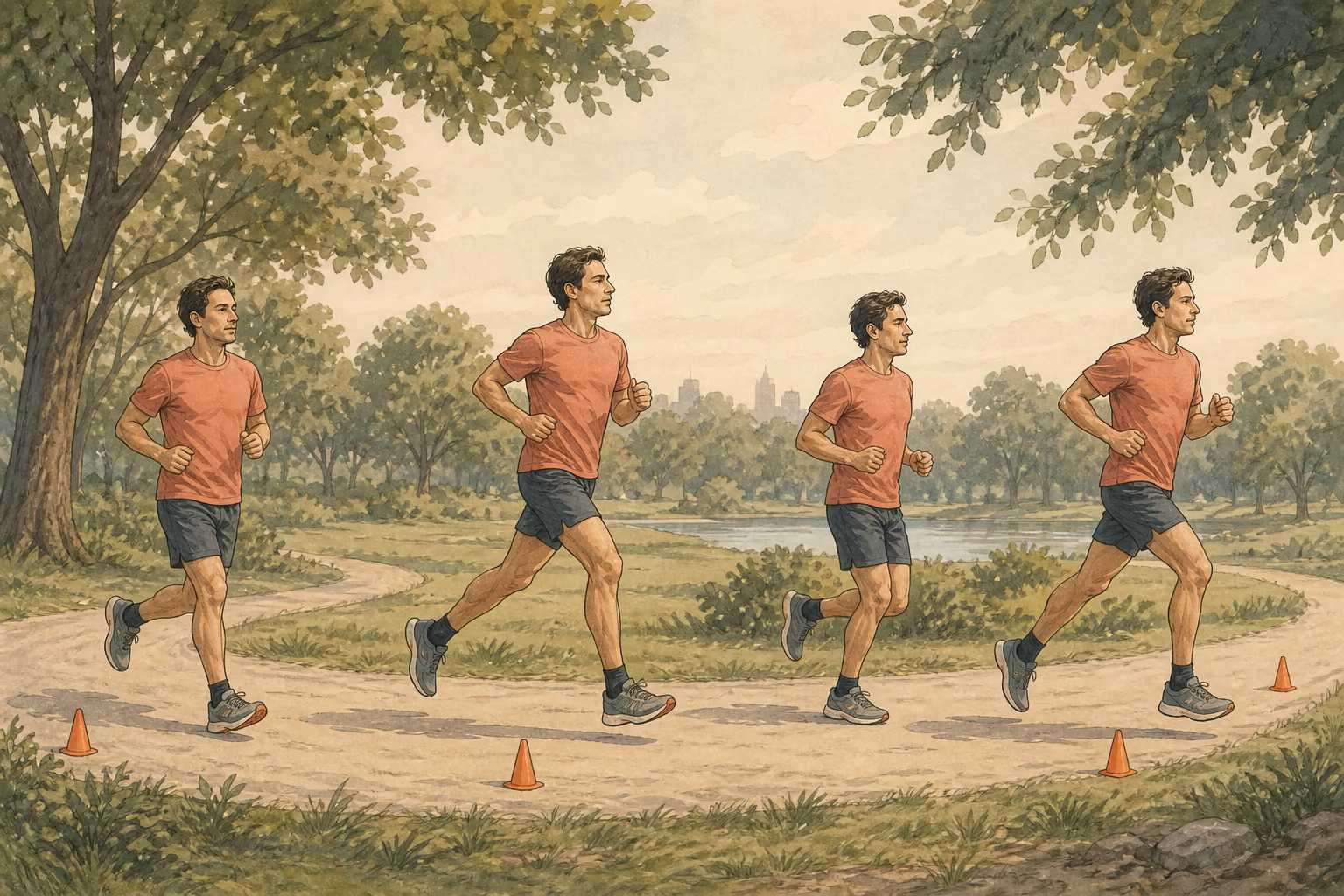
What threshold feels like from the first minute to the last
Opening minutes
The pace should feel almost conservative. Breathing deepens, but you do not need to brace or bargain. If you already feel “on the edge” after two minutes of a six-minute repetition, slow down before the effort compounds.
Middle of the block
Breathing is strong and rhythmic. You can say two or three words, but not hold a conversation. RPE is often around 7 for experienced runners, though the number is only useful when paired with cues. Shoulders stay down, stride remains under you, and pace does not require repeated surges.
Final work
RPE may move toward 8. You know you are working, yet one more short repetition would be plausible if required. The final pace should not be dramatically faster than the rest. A sprint finish proves spare anaerobic speed, not accurate threshold execution.
After the cooldown
Fatigue is clear but not wrecking. Normal easy running should be possible after appropriate recovery. If the session produces several days of heavy legs or disrupts the long run, reduce total work, pace, or placement before repeating it.
Tempo, threshold, race pace, and intervals are not interchangeable
| Session | Typical feel | Common structure | Primary mistake |
|---|---|---|---|
| Steady tempo | RPE 5–6, controlled conversation in short phrases | 20–40 minutes continuous | Drifting to threshold without planning it |
| Threshold | RPE 7–8 late, few-word speech | 15–35 total work minutes continuous or broken | Starting at 10K race effort |
| Half-marathon pace | Specific rhythm; difficulty depends on race duration | Repeated or continuous race-pace segments | Using an aspirational pace as current fitness |
| Aerobic intervals | RPE 8–9 late, faster rhythm | 2–5 minute repetitions with recovery | Treating each rep as a sprint |
Find threshold pace without pretending the estimate is exact
Use a recent, well-paced performance rather than a goal. A VDOT calculation can translate that result into a threshold range. Short races are useful when the runner has enough endurance to make the equivalence plausible. A fast 5K from a speed-oriented runner may produce a threshold pace that is difficult to support with current volume; begin at the slower edge and use broken repetitions to confirm it.
A field alternative is a controlled 30-minute time trial, but a maximal test carries its own recovery cost and is inappropriate for some runners. If used, the test must be paced evenly, not as a ten-minute sprint followed by survival. You do not need to test when a recent race already exists. The safest practical approach is triangulation: calculator range, RPE 7–8 late, few-word speech, and stable repetitions.
Threshold pace is a range because conditions matter. On a rolling route, hold the effort up the hill and let pace slow. In warm weather, accept a slower pace from the start. On a treadmill, use perceived effort and avoid assuming the displayed speed exactly matches outdoor running. The correct threshold pace is the one you can organize into repeatable work today.
Four fully specified threshold sessions
Choose one format that matches your current experience. Total threshold time matters more than collecting harder-looking sessions.
Entry-level cruise intervals
Learn threshold effort with frequent opportunities to correct pace.
- Structure
- 15 minutes easy; 4 relaxed strides; 5 × 4 minutes threshold with 90 seconds easy jog; 10–15 minutes easy.
- Effort
- Start RPE 6–7 and finish near 7–8. Pace should remain within a narrow range; no rep faster than the first by more than normal terrain variation.
- Recovery
- 90 seconds very easy jogging or jog-walk. Restore breathing, not full freshness.
- Progression
- Add a sixth repetition in a later week before lengthening reps or shortening recovery.
Classic broken threshold
Accumulate 24 minutes of sustained controlled work with minimal pace drift.
- Structure
- 15–20 minutes easy; 4 × 6 minutes threshold; 90 seconds easy jog; 10–15 minutes easy.
- Effort
- Deep stable breathing, RPE 7 rising toward 8. Begin at the slower edge of the calculated range.
- Recovery
- Keep jogging slow enough to regain posture. Do not turn recovery into steady running.
- Progression
- Move to 3 × 8 minutes with 2-minute jogs, preserving total work before adding more.
Two long threshold blocks
Practice settling into longer uninterrupted work for an experienced runner.
- Structure
- 20 minutes easy plus strides; 2 × 12–15 minutes threshold with 3 minutes easy jog; 15 minutes easy.
- Effort
- First block controlled enough that the second can match it. RPE 7 early, no higher than 8 late.
- Recovery
- Three minutes easy jog. Start the second block on time, not early because you feel good.
- Progression
- Extend each block by 2–3 minutes only after two even executions; do not make both longer and faster.
Continuous tempo-to-threshold progression
Teach restraint and a gradual transition from steady to threshold effort.
- Structure
- 20 minutes easy; 10 minutes steady, 10 minutes lower threshold, 5 minutes controlled threshold; 15 minutes easy.
- Effort
- RPE progresses from 5–6 to 7–8. Each change should feel deliberate, not like a sprint at a mile marker.
- Recovery
- No interval recovery; the earlier steady segment must be slow enough to preserve the final five minutes.
- Progression
- Add five minutes to the steady portion, not the fastest portion, if more volume is appropriate.
Runner scenario
Scenario: Elena's tempo pace is secretly her 10K race pace
Elena
A 31-year-old runner with a recent 10K personal best, averaging 22 miles per week and training for her first goal-oriented half marathon.
- The decision
- She runs a prescribed 25-minute tempo at nearly 10K pace. The first ten minutes feel powerful; pace fades, shoulders tighten, and she skips two easy days because her calves remain sore.
- Recommended approach
- Replace the continuous tempo with 5 × 4 minutes at the slow edge of her calculated threshold range, separated by 90-second easy jogs. Keep the first and fifth repetitions within the same effort and stop without a finishing sprint.
- Why
- Elena needs pace calibration and repeatable time near threshold, not proof that she can suffer. Broken work gives her five checkpoints. Lower acute cost also protects the weekly volume that supports half-marathon endurance.
Pace the first repetition so the session can teach you something
- 1
Warm up until easy pace settles
Use 15–20 minutes for most formal sessions, longer in cold weather or when you usually need time. Add familiar strides, not novel drills.
- 2
Start at the slow edge
The first minute should not feel like the workout has begun all at once. Allow breathing and pace to rise into the range.
- 3
Check at halfway
Ask whether breathing is stable and whether one more full block would be plausible. Slow now if the answer is no.
- 4
Jog the written recovery
Recovery is not wasted training. Keep it easy and complete the planned duration.
- 5
Match, do not beat
Aim for a final repetition that resembles the first. Do not chase a fastest split as proof of fitness.
- 6
Cool down without mileage debt
Run easily until breathing settles. Shorten the cooldown if fatigue or discomfort makes extra distance unhelpful.
Common threshold failures and the direct correction
The first repetition is the fastest
Begin the next session 5–10 seconds per mile slower or reduce effort by one RPE point. A threshold set should compress, not explode. Pace can rise later only if control remains.
Recovery gets faster every time
Make recovery deliberately slow. If you feel embarrassed by the jog pace, remember its job is to preserve work quality. Record work pace separately from total-run average.
The session becomes a weekly test
Repeat the same structure for two or three exposures. Training is the controlled dose; racing yourself each week obscures whether you are adapting or merely trying harder.
Threshold appears beside another hard day
Move strength that causes soreness, intervals, or a hard group run away from the session. Count a fast long run as quality. Two demanding workouts require easy space between them.
Pace is forced in heat or on hills
Run by effort or choose a flatter, cooler setting. A slower split at the same threshold effort preserves the workout. Fighting terrain produces surges that change it.
How much threshold work belongs in one week?
For runners new to structured quality, 12–20 total minutes at controlled threshold can be enough. Established runners may accumulate roughly 20–35 minutes, often through repetitions. These are practical examples, not universal dose rules. A 20-mile-per-week runner and a 55-mile-per-week runner do not absorb the same session simply because their threshold pace is calibrated.
Count all demanding work. A week with a race-pace long run, hilly group run, and strength session may not have room for 30 minutes of threshold. Add volume only when repetitions remain even and the following easy days are normal. Progress one lever: another repetition, a slightly longer repetition, or reduced recovery—not all three.
Threshold typically fits after an easy day and at least two or three days before a demanding long run. Runners with three running days may use one threshold session, one easy run, and one easy long run. More frequent runners can surround it with easy volume. The distribution review in the source list describes successful endurance programs as containing substantial low-intensity work; it does not establish one perfect ratio for every recreational half-marathon runner.
Modify threshold work for real-world constraints
| Constraint | Modification | Keep constant | Do not do |
|---|---|---|---|
| New to workouts | Use 6 × 3 minutes | Controlled RPE and full recovery | Copy an advanced 30-minute tempo |
| Rolling route | Run by effort or use time laps | Stable breathing | Surge uphill to hold pace |
| Hot weather | Slow the range and shorten if needed | Purpose and RPE | Use cool-weather splits |
| Limited time | Shorten warm-up only within what feels safe; use 4 × 5 minutes | Quality of work | Skip warm-up and start hard |
| Tired after long run | Move or replace with easy running | Recovery between quality days | Force the workout to preserve the calendar |
Use the right threshold format for the route
Track
The track makes distance and lap consistency clear, but it can tempt runners to treat threshold as a race. Convert the workout into time or relaxed lap ranges and alternate direction only when facility rules allow. Avoid staring at every 100-meter mark; check each lap or each full repetition so small fluctuations do not trigger surges.
Rolling road
Use effort over the crest and allow pace to slow before the hill becomes urgent. Resume rhythm gradually on the descent rather than sprinting to recover the average. Time-based blocks work better than exact mile repeats when grade changes repeatedly.
Treadmill
A treadmill offers stable pacing, which can teach restraint, but the displayed speed is machine-specific and indoor heat can raise effort. Use a fan, begin at the slower edge, and adjust from breathing and RPE. Do not use a universal incline to claim exact outdoor equivalence.
Loop
A short park loop can provide natural checkpoints and reliable support access. Start work and recovery at the same landmarks only when it does not force awkward duration changes. Prioritize the written work time over making the loop mathematically tidy.
Progress threshold work across a training block
A simple four-exposure sequence might begin with 5 × 4 minutes, then 4 × 6 minutes, then 3 × 8 minutes, then 2 × 12 minutes. Total work stays near 20–24 minutes while uninterrupted duration grows. This is not the only sequence, but it demonstrates one-variable progression. The pace and recovery do not also need to become more aggressive.
Repeat an exposure when execution is uneven. Progression is earned when the first and last blocks resemble one another, RPE rises gradually, and the next easy days remain useful. If the set fades, return to the prior duration or slow the range. A repeated session is not a wasted week; it creates the comparison needed to make a good decision.
In the half-marathon-specific phase, some threshold work can shift toward realistic race pace with longer, slightly easier blocks. For example, 3 × 12 minutes at half-marathon effort is not a harder version of 4 × 6 minutes at threshold; it asks a different question about race rhythm. Keep the labels and purposes separate so race-pace work does not creep upward into another threshold test.
During the taper, preserve a small familiar dose and reduce total work. Two or three short blocks can remind you of rhythm without creating a new adaptation target. If fresh legs make the pace feel easy, finish the written session. The taper succeeds by reducing fatigue, not by discovering how hard you can train close to race day.
Your next action: choose one repeatable threshold format
Calculate a starting range from a recent result with the free VDOT calculator, then choose the entry-level or classic broken session. Write three guardrails before you begin: pace range, RPE ceiling, and stop rule. Afterward, compare the first and final work segments and note the next day's response. Repeat the same structure before progressing it.
If the range and effort disagree, preserve effort and revise the estimate. A personalized plan can place threshold work around your long run, available days, and race date. Its usefulness is not that it makes threshold harder; it is that it keeps the workout proportional to the rest of your training.
For the first review, ignore the fastest split. Compare work-time total, pace variation, RPE at the end of each block, and whether the written recovery remained enough. If every block was smooth and the final RPE stayed below the intended range, keep the same session once more or add a small amount of work. Do not automatically speed up; threshold development is also the ability to hold control for longer. Add faster repetitions only after understanding how interval workouts differ from threshold work.
Put it into a plan
Turn this guidance into your next useful step.
Use a free resource to explore your options, or build a race-specific plan around your date, availability, and current fitness.
Calculate your VDOTKeep learning
Related resources
Half Marathon Easy Run Pace
Learn how easy your easy runs should feel during half marathon training and why controlling effort supports the rest of your plan.
Read guideInterval Workouts for Half Marathon Training
Use interval workouts to add controlled speed to half marathon training without crowding out easy mileage and long-run recovery.
Read guideHalf Marathon Race Pace Strategy
Build a half marathon race pace strategy with a realistic opening effort, controlled adjustments, and practice from training runs.
Read guideQuestions runners ask
- What pace should threshold runs be?
- Use a performance-based threshold range from a recent representative race, then confirm it with RPE 7–8 late, few-word speech, and even execution. Conditions and endurance background matter. Start at the slower edge and adjust when breathing or form says the number is too ambitious.
- Is half-marathon pace the same as threshold pace?
- Not usually. Half-marathon pace is race-specific and depends on how long you will be running. Threshold is a physiological and practical boundary region. For faster runners they may sit closer together; for runners spending more time on course, half-marathon pace is often distinctly easier.
- Are broken threshold intervals as useful as a continuous tempo?
- They are a useful way to accumulate controlled work, especially while learning pace. Short recoveries reduce uninterrupted strain and create checkpoints. A continuous tempo adds sustained pacing demand. Choose the format that preserves the intended effort; one is not automatically superior.
- How long should a threshold workout last?
- Newer runners might begin with 12–20 total work minutes; experienced runners may use 20–35. Total weekly mileage, history, and other quality sessions matter. Warm-up, recovery jogs, and cooldown add to the session but are not threshold minutes.
- Can I do threshold workouts every week?
- Many established runners do, but not every week needs the same dose. Replace or reduce it around races, unusually demanding long runs, illness, or disrupted recovery. The session belongs only when it supports the larger block.
- Should I use heart rate for threshold repetitions?
- Heart rate can support longer blocks after it has time to respond, but it lags at the start and varies with heat, stress, and sensor accuracy. Use pace and RPE to begin; review heart rate as context rather than accelerating to reach a target quickly.
- What should I do if threshold pace fades?
- Slow immediately, extend the next recovery, or end the set if control does not return. Review the opening pace, conditions, recent training, and total work. Do not sprint the final repetition to improve the average.
Sources and methodology
This guide is educational, not medical advice. It is written from general training principles and linked primary or official references; use judgment for your own conditions and consult a qualified professional for individual health concerns. Read our editorial methodology.
- ACSM's Guidelines for Exercise Testing and Prescription — American College of Sports Medicine. General exercise-training principles and progression guidance.
- Physical Activity Basics — Centers for Disease Control and Prevention. Public-health guidance on physical activity and its role in health.
- Anaerobic threshold: the concept and methods of measurement — Canadian Journal of Applied Physiology. Review explaining that different threshold methods identify related but non-identical intensities and contain method-specific error.
- The training intensity distribution among well-trained and elite endurance athletes — Frontiers in Physiology. Review of pyramidal, polarized, and threshold-heavy intensity distributions; evidence primarily concerns trained endurance athletes and does not establish one mandatory recreational ratio.
- Criterion-related validity of the Borg ratings of perceived exertion scale in healthy individuals: a meta-analysis — Journal of Sports Sciences. Evidence that ratings of perceived exertion are useful but imperfect and vary in their relationship with physiological measures.