Half marathon guide
Half Marathon Easy Run Pace
Easy runs should feel controlled enough that you can speak in short sentences and finish with energy left. Their job is to build aerobic volume and support recovery, not to produce a daily fitness test.
The short answer
Easy runs should feel controlled enough that you can speak in short sentences and finish with energy left. Their job is to build aerobic volume and support recovery, not to produce a daily fitness test.
Easy pace is the speed that keeps an easy run useful
An easy run should feel controlled enough that you can speak in complete sentences, keep your shoulders and hands relaxed, and finish without turning the final mile into a test. For many runners that lands around RPE 2–4 on a 1–10 scale. The pace may change substantially with heat, hills, sleep, and accumulated training. The purpose does not: add aerobic running you can recover from while supporting the harder work elsewhere in the week.
The most common mistake is to ask, “What number proves I am running easy?” A calculator can suggest a range from a recent performance, but no single pace can remain correct across a windy bridge, a humid afternoon, and a flat cool track. Easy pace is a decision made with several clues: conversation, breathing, muscular tension, heart-rate trend, and what the run costs afterward. The heart rate vs. pace guide shows how those signals share the job when they disagree.
This guide will help you establish a starting range, adjust it while running, and recognize when “easy” has drifted into moderate. The examples are educational, not personal prescriptions. If running produces chest pain, faintness, severe symptoms, or pain that changes your gait, stop and seek appropriate assessment rather than trying to fix the pace.
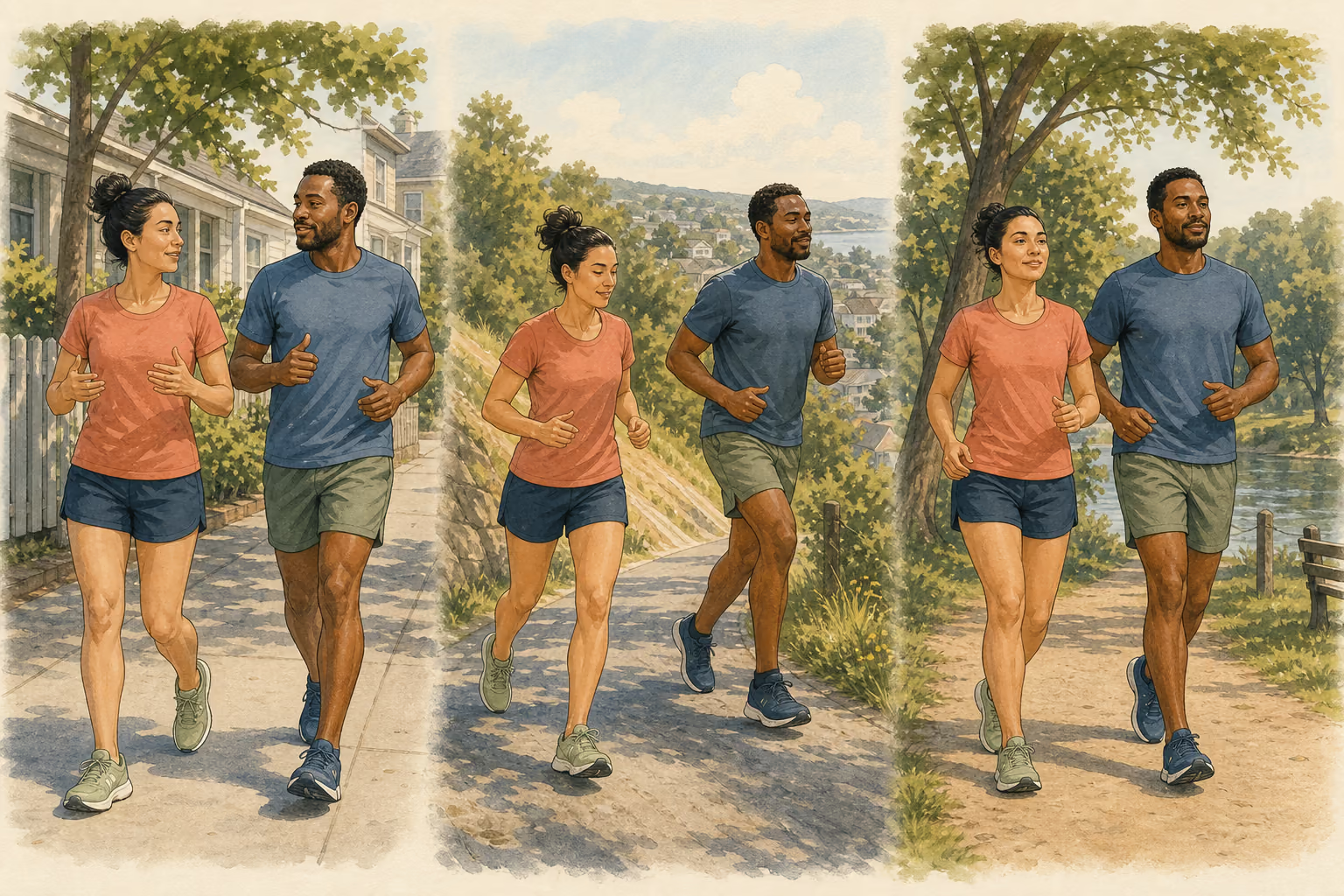
Use five cues instead of trusting one number
Conversation
You should be able to say a normal sentence without planning the breath between every few words. A brief hill may interrupt speech, but conversation should return when the grade eases. If you can answer only with clipped phrases for several minutes, slow down.
Breathing
Breathing is noticeable but not urgent. You are not trying to breathe silently; you are looking for a rhythm that stays stable. Repeated gasps, a need to brace, or breathing that climbs continuously on flat ground suggests the effort has moved beyond easy.
Muscular tension
Hands remain loose, shoulders do not rise toward the ears, and the stride does not reach aggressively in front. Easy pace can still feel mechanically awkward at first, especially for faster runners. Shorten the stride slightly rather than forcing an unnaturally slow shuffle.
Heart-rate trend
Heart rate can add context after the opening 10–15 minutes, once the response has settled. It may rise gradually during a long run even when speed stays constant—a pattern called heart-rate or cardiovascular drift. Use the trend alongside conditions and effort; do not chase every beat by repeatedly surging and braking.
Recovery cost
The next day provides the final clue. An easy run can leave normal training fatigue, but it should not create the recovery demand of a workout. If easy days repeatedly make the quality session worse, they are too long, too fast, or too numerous for the current week.
How to calculate a starting easy-pace range
Start with a recent race or hard, well-paced effort that reflects current fitness. A VDOT-style calculator translates the performance into training ranges. Treat the easy range as a broad starting corridor, not a daily command. Short-race fitness can overstate what a runner with limited endurance can comfortably repeat, and a race completed in extreme conditions can understate fitness. A representative result is usually recent, measured accurately, and completed without a dramatic blow-up.
For example, suppose the calculator suggests 9:45–10:45 per mile. Begin an ordinary flat run near the slower half. After 10–15 minutes, check speech, breathing, and posture. If all remain relaxed, there is no need to speed up merely because the watch shows 10:35. If 10:45 feels strained, slow beyond the range. The body does not recognize the edge of a calculator box.
Recalibrate after a meaningful new race or several weeks of changed fitness, not after one impressive easy run. Faster easy pace can emerge as a result of fitness, cooler weather, or freshness; it is not a workout goal. The better sign is that the same comfortable effort covers more ground across comparable conditions while the rest of training remains stable.
When the watch and your effort disagree
| Situation | What pace may do | Best response | Why |
|---|---|---|---|
| Warm, humid afternoon | Slows at the same effort | Use conversation and RPE; accept slower splits | Cooling and cardiovascular strain change the cost of speed |
| Long gradual hill | Slows markedly | Shorten stride and keep breathing controlled | Holding flat pace would turn the hill into a workout |
| Tailwind or gentle descent | Speeds up | Let pace improve only while posture stays quiet | Braking to an exact number can be as artificial as forcing speed |
| Poor sleep or heavy training week | May slow | Shorten or slow the run | Easy running should support the week, not collect mileage at any cost |
| Group run accelerates | Speeds beyond range | Choose a slower group or let them go | Conversation can hide intensity when social pressure sets the pace |
| First mile feels stiff | Starts slow | Keep it slow until rhythm arrives | A warm-up is not evidence that fitness disappeared |
Three ways to practice easy-running control
These are observation exercises, not tests. They should make easy running easier to judge, not make the day harder.
Conversation calibration run
Connect speech and breathing to watch pace on a familiar route.
- Structure
- 35–45 minutes easy. At minutes 10, 20, and 30, say two complete sentences aloud or talk with a partner; note pace only after the sentence.
- Effort
- RPE 2–4 with relaxed posture. Slow down if speech becomes clipped on flat ground.
- Recovery
- No interval recovery is required. Walk briefly if needed to restore easy effort rather than forcing a jog.
- Progression
- Repeat in different weather and compare effort notes, not just average pace.
Hill-governed easy run
Learn to let pace change while keeping effort stable.
- Structure
- 40–55 minutes on a gently rolling route. Run descents naturally and reduce speed before breathing spikes on climbs.
- Effort
- Keep conversation available. On steeper grades, a purposeful walk is an acceptable easy-effort tool.
- Recovery
- Use the flat or descent to settle; do not surge to recover lost average pace.
- Progression
- Choose a slightly hillier route only when the next-day cost remains ordinary.
Easy run with relaxed strides
Preserve quick, smooth mechanics without turning the run moderate.
- Structure
- 30–50 minutes easy, then 4–6 × 20-second relaxed strides on flat ground with 60–90 seconds walking or easy jogging.
- Effort
- Easy run at RPE 2–4; strides quick and fluid, never all-out. Stop each before tension appears.
- Recovery
- Recover fully enough that each stride feels coordinated.
- Progression
- Add one or two strides before making them faster; six controlled strides are enough for most purposes.
Runner scenario
Scenario: Ben's easy pace works in spring and fails in summer
Ben
A 36-year-old runner training four days per week, with a cool-weather easy range of 9:20–9:55 per mile.
- The decision
- In July humidity, 9:40 pace produces RPE 6 and clipped speech by 25 minutes. He slows briefly whenever heart rate rises, then speeds up to protect his average, creating repeated surges.
- Recommended approach
- Ignore average pace for two weeks. Start around 10:15–10:30, cap effort at conversational RPE 4, and use a short planned walk on the exposed hill. Review heart rate after the run rather than chasing it live.
- Why
- Ben's old pace describes different conditions. The surge-and-brake pattern adds strain without improving the easy-run purpose. A slower, steadier effort gives him more useful volume and preserves the threshold session later in the week.
Why easy runs become too hard
The range becomes a leaderboard
Runners often aim for the fast end because it looks like progress. Correct it by hiding current pace for the first 15 minutes and displaying lap pace later. If effort is right at the slower edge, stay there.
The group decides the intensity
A social run can feel emotionally easy while being physiologically moderate. Agree on a conversation pace before starting, choose companions with a compatible easy speed, or separate when the route turns into an unplanned progression.
Every run finishes faster
An occasional controlled progression can be planned. A habitual fast final mile teaches you to spend the easy day's recovery budget. Finish the next three easy runs at the same effort as the middle, even if you feel strong.
Distance is fixed despite fatigue
Easy does not mean cost-free. If 50 minutes becomes strained after a hard week, reduce it to 35–40. Preserving frequency may be more useful than completing arbitrary mileage with poor control.
A slow pace feels embarrassing
Public pace is not the training goal. Use time instead of distance, turn off automatic social uploads, or run an effort-governed route. Training only works when the runner doing it can recover.
Heart-rate drift does not automatically mean the run failed
Heart-rate drift is a gradual rise in heart rate during prolonged steady exercise even when pace changes little. Heat, hydration status, duration, and fatigue can contribute. A small late rise paired with stable breathing may simply describe the day's conditions. A steep rise alongside increasing RPE and declining pace is more useful evidence that the effort or duration no longer fits.
Avoid using a rigid heart-rate ceiling as an emergency brake on every hill. Heart rate responds after the work; by the time the number rises, the grade may already be ending. Govern the climb with effort, then observe whether the response settles. Chest straps generally reduce motion-related noise compared with wrist optical sensors, but no consumer reading deserves an instant training overhaul based on one anomaly.
If readings are repeatedly surprising, check sensor placement, battery, and whether the pattern matches breathing and symptoms. Unexpected heart-rate behavior with concerning symptoms belongs in a medical conversation. Training content cannot determine the cause.
Correct an easy run while it is happening
- 1
Notice the first sustained mismatch
One hill or traffic crossing is noise. Several minutes of clipped speech, rising tension, or RPE above 4 is a pattern.
- 2
Reduce effort decisively
Slow by enough to restore control; shuffling five seconds per mile slower may not change anything. Walk 30–60 seconds if that is the cleanest reset.
- 3
Remove the pace debt
Do not speed up later to recover the average. The lost seconds are evidence of correct adjustment, not a debt.
- 4
Shorten if control does not return
A planned 50-minute run can become 35 minutes. The next workout benefits more from the correction than from forced completion.
- 5
Record the reason
Note temperature, terrain, sleep, and previous training. Patterns across runs help separate one difficult day from a range that needs recalibration.
Easy pace for common runner starting points
| Starting point | Primary guardrail | Useful format | Avoid |
|---|---|---|---|
| New run-walk runner | Breathing returns during walks | 2–4 minutes easy run / 1 minute walk | Lengthening every run interval at once |
| Beginner running three days | Full-sentence conversation | Two short easy runs plus an easy long run | Making the short runs tempo days |
| Intermediate adding volume | Next-day readiness | Add 5–10 easy minutes to one run | Adding pace and duration together |
| Experienced runner after race | Low RPE and normal gait | Short recovery runs or rest | Using easy pace to prove recovery |
| Runner in heat or hills | Effort and breathing | Time-based route with planned walks | Forcing cool-weather pace |
Easy effort on a treadmill, trail, and run-walk plan
Treadmill
Treat the displayed pace as that machine's estimate, not a guaranteed outdoor equivalent. Belt calibration, airflow, temperature, and running familiarity change perceived cost. Begin with zero to one percent incline only if it feels natural; there is no need to use a fixed incline as a universal correction. Use conversation and RPE, and add a fan when indoor heat makes heart rate climb.
Avoid increasing speed every few minutes because the controls make it easy. A successful treadmill easy run can look visually monotonous. If stride feels cramped at a very slow belt speed, use short walk breaks and a comfortable conversational running speed rather than shuffling.
Trail
Trail pace reflects footing, turns, grade, and attention. Compare time and effort, not road pace. Walk technical climbs early, shorten stride on uncertain ground, and let descents remain controlled. The cognitive work of terrain can raise perceived effort even when the cardiovascular load is modest.
Run-walk
Use planned intervals before fatigue forces them. A runner might use four minutes conversational running and one minute purposeful walking for 40 minutes. Keep the running segment easy rather than racing because a walk is coming. Progress either total time or the run-to-walk ratio, not both in one step.
Use decoupling as a question, not a score
Some platforms compare pace with heart rate across the first and second halves of a run and call the change “decoupling.” The idea is straightforward: if pace falls while heart rate rises, the internal cost of the same output has changed. But the calculation is highly sensitive to hills, stops, heat, sensor noise, and whether the halves contain comparable terrain.
A clean comparison needs a steady route, sustained duration, reliable sensor, and broadly stable conditions. Even then, do not use a single percentage as a fitness verdict. Ask what happened: Did conversation disappear? Did the final hill occur only in the second half? Did the wrist sensor lock onto cadence? Did you forget fluid on an unusually warm day?
The practical value is trend review. If repeated flat easy runs show rising RPE, slower late pace, and larger heart-rate drift, reduce intensity or duration and inspect the surrounding week. If pace and speech stay stable while the metric moves slightly, no emergency correction is required. Training decisions should follow converging evidence.
The next action: establish your own easy-effort evidence
Use the VDOT calculator to create a starting range from a representative recent result. Then complete the conversation calibration run on a familiar route and record three things: the pace range that emerged after 15 minutes, RPE near the end, and how the next run felt. Repeat once in different conditions. You now have a practical easy-effort profile rather than a borrowed number.
If easy days remain difficult even after slowing, look at the whole week: total duration, quality sessions, long-run load, strength work, sleep, and illness. The solution may be fewer minutes, not an even slower shuffle. A personalized race plan can sequence easy volume around your actual days and race date; its value is the relationship among sessions, not a single pace target.
Keep one control route—a safe 30–45 minute loop you can repeat in ordinary conditions. You are not trying to set a record there. You are building a reference for how easy breathing, pace, and heart-rate trend interact. Compare monthly rather than daily, and note weather. A stable reference makes it easier to spot when the week is too demanding without turning every easy run into a fitness test.
Put it into a plan
Turn this guidance into your next useful step.
Use a free resource to explore your options, or build a race-specific plan around your date, availability, and current fitness.
Calculate your VDOTKeep learning
Related resources
Tempo and Threshold Workouts for a Half Marathon
Understand controlled tempo and threshold workouts, how they fit half marathon training, and how to avoid turning them into race efforts.
Read guideHeart Rate Zones vs. Running Pace for Half Marathon Training
Compare heart rate, pace, and perceived effort for half marathon training and learn when each signal can be most useful.
Read guideWhy Your Easy Runs Keep Turning Hard
Understand why easy runs drift too fast, what that does to half marathon training, and how to make easy effort feel productive again.
Read guideQuestions runners ask
- How much slower than half-marathon pace should easy pace be?
- There is no dependable universal gap. Faster and slower runners have different pace relationships, and conditions change the cost. Use a performance-based range as a starting point, then require full-sentence conversation, RPE around 2–4, and ordinary recovery. The resulting difference may vary from day to day.
- Is Zone 2 always the same as easy running?
- Not necessarily. Zone systems use different numbers and thresholds, and age-predicted maximum heart rate can be inaccurate for an individual. Easy running is a practical purpose. Heart rate can support that judgment, but conversation, breathing, and recovery cost remain important.
- Can my easy pace be too slow?
- If the pace changes your mechanics into an uncomfortable shuffle, alternate relaxed running with brief walks or use a slightly quicker but still conversational stride. The issue is not the number; it is whether you can move comfortably at low effort and recover. Strides after some easy runs can preserve smooth quicker mechanics.
- Why is my easy pace slower after a rest day?
- One day can reflect heat, sleep, stress, route, fueling, or normal variability. Do not interpret it as lost fitness. Use effort cues and look for patterns over several comparable runs. A rest day does not guarantee fast legs.
- Should I walk on hills during an easy run?
- Yes, when walking is the simplest way to keep the intended effort. Begin walking before breathing becomes urgent, keep moving purposefully, and resume running after the grade eases. This is effort control, not a failed run.
- Do easy runs need a warm-up?
- The opening easy minutes are usually the warm-up. Start slower than the eventual cruising pace and let rhythm arrive. You do not need drills unless they serve a known purpose or you plan to add strides or faster work.
- How often should I update my easy pace?
- Update after a representative race or a clear multiweek change, not after every run. Keep notes across similar routes and conditions. If the same easy effort is consistently faster while recovery remains stable, the range may have shifted.
Sources and methodology
This guide is educational, not medical advice. It is written from general training principles and linked primary or official references; use judgment for your own conditions and consult a qualified professional for individual health concerns. Read our editorial methodology.
- ACSM's Guidelines for Exercise Testing and Prescription — American College of Sports Medicine. General exercise-training principles and progression guidance.
- Physical Activity Basics — Centers for Disease Control and Prevention. Public-health guidance on physical activity and its role in health.
- Criterion-related validity of the Borg ratings of perceived exertion scale in healthy individuals: a meta-analysis — Journal of Sports Sciences. Evidence that ratings of perceived exertion are useful but imperfect and vary in their relationship with physiological measures.
- The training intensity distribution among well-trained and elite endurance athletes — Frontiers in Physiology. Review of pyramidal, polarized, and threshold-heavy intensity distributions; evidence primarily concerns trained endurance athletes and does not establish one mandatory recreational ratio.