Half marathon guide
Heart Rate Zones vs. Running Pace for Half Marathon Training
Heart rate, pace, and perceived effort each describe a different part of a run. Pace is immediate and route-specific, heart rate reflects a delayed physiological response, and perceived effort captures conditions neither number fully explains. Use the combination that keeps the workout’s purpose clear.
The short answer
Heart rate, pace, and perceived effort each describe a different part of a run. Pace is immediate and route-specific, heart rate reflects a delayed physiological response, and perceived effort captures conditions neither number fully explains. Use the combination that keeps the workout’s purpose clear.
Pace, heart rate, and effort answer different questions
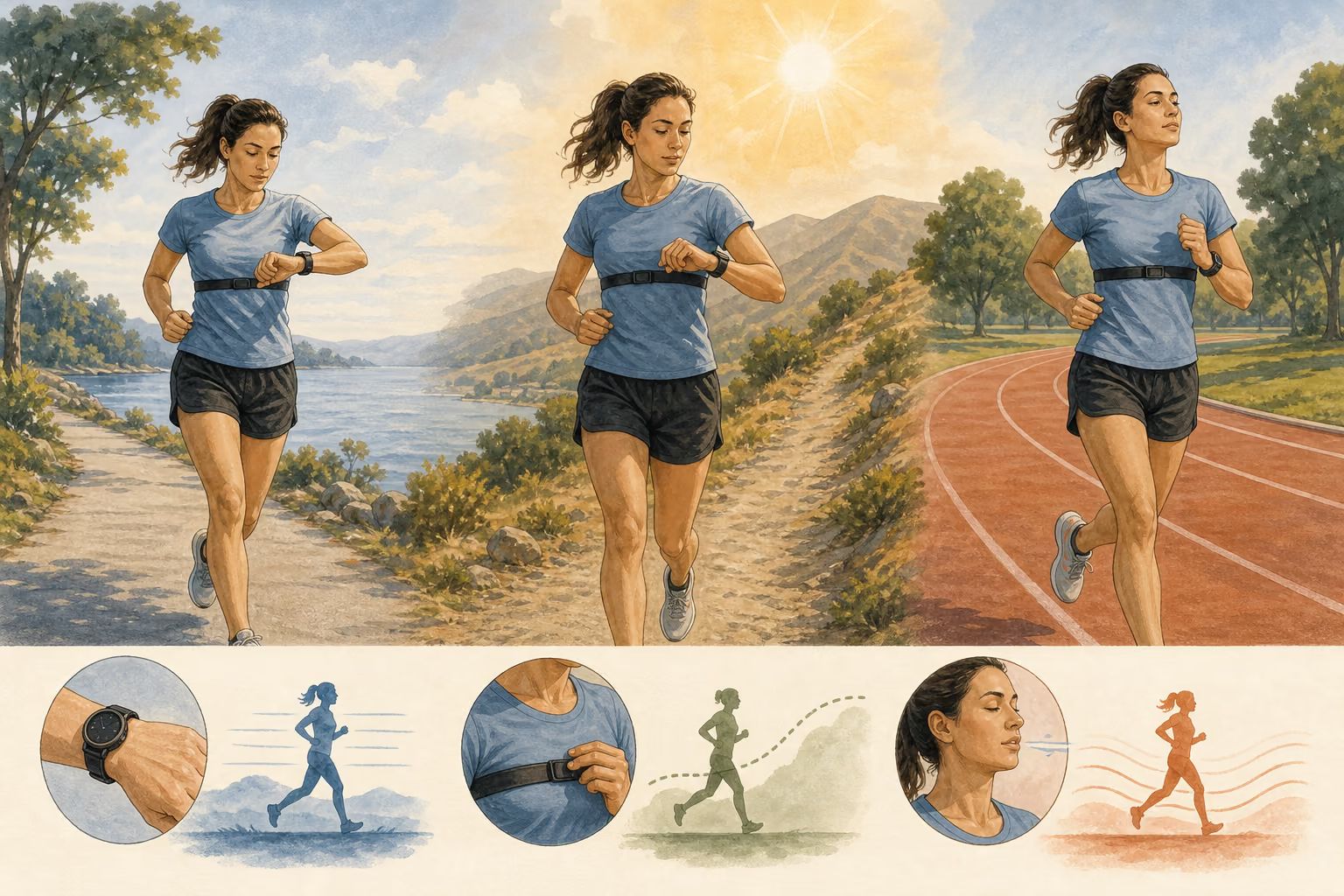
Pace tells you external speed: how long it takes to cover a mile or kilometer. Heart rate describes part of your internal response: how frequently the heart is beating at that moment. Rating of perceived exertion, or RPE, is your 1–10 judgment of the whole task, including breathing, muscular strain, heat, terrain, and fatigue. None is “best” in every situation.
Use pace when the route and workout make speed meaningful, such as controlled track repetitions or race-pace rehearsal on comparable terrain. Use heart rate to add context during sustained easy or steady running after the response has settled. Use RPE and breathing to interpret conditions that neither number fully captures. The most reliable training decision usually comes from agreement among two or three signals, not obedience to one.
When they disagree, ask why. A hot uphill can produce slow pace, high heart rate, and moderate-to-hard RPE; the correct response is usually to slow, not chase flat-route pace. A short interval can show fast pace and high RPE while heart rate lags; accelerating to “reach the zone” would overshoot. This guide provides a decision framework, not medical interpretation of heart-rate data.
What each metric is good at—and where it fails
| Metric | Best use | Main limitation | Practical safeguard |
|---|---|---|---|
| Pace | Flat steady runs, measured reps, race rhythm | Cost changes with weather, wind, grade, surface | Use a range and pair with RPE |
| Heart rate | Sustained easy/steady context, trend review | Lag, drift, individual max, sensor error | Wait for settling and verify with breathing |
| RPE | Hills, heat, fatigue, any metric disagreement | Subjective and learned through practice | Record cues, not a number alone |
| Talk test | Easy-to-moderate boundary | Crude during short reps or solo silence | Use complete sentences at easy effort |
Understand heart-rate zones before using them
Maximum-heart-rate zones
These zones use percentages of estimated or measured maximum heart rate. The familiar age formulas describe population averages and can miss an individual's true maximum by many beats. Tanaka and colleagues proposed 208 minus 0.7 times age from pooled data; even a better population equation is not a personal measurement.
Heart-rate-reserve zones
Heart-rate reserve uses the difference between maximum and resting heart rate, then adds resting heart rate back to the target. It incorporates one more individual value, but still depends on a credible maximum and a properly measured resting rate.
Threshold-heart-rate zones
These organize intensity around an estimated lactate- or ventilatory-threshold heart rate. They can be more performance-specific, but field tests are demanding and estimates vary. A wearable's automatic threshold is a model, not a lab finding.
Three-zone and five-zone systems
Zone labels are not universal. “Zone 2” in a three-zone research model may not equal Zone 2 in a five-zone watch. Compare definitions and boundaries before copying advice. The purpose and cues matter more than the color on the screen.
Heart-rate lag and drift explain many confusing runs
Heart-rate lag is the delay between a change in running intensity and the full heart-rate response. During a three-minute repetition, pace and breathing rise immediately while heart rate climbs over time. If you accelerate until the watch reaches a target in the first minute, you may run faster than intended; the number catches up after the pacing mistake has already been made.
Heart-rate drift, often called cardiovascular drift, is a gradual rise during prolonged steady exercise even when pace stays similar. Heat and duration can contribute as the cardiovascular system manages cooling and fluid shifts. Drift does not automatically prove poor fitness or dehydration. Interpret its size with RPE, pace change, conditions, and symptoms.
For an easy run, let the first 10–15 minutes settle before judging. On short hills, govern effort and observe the response afterward rather than braking at every beat. In a long run, a modest late rise with stable conversation may be acceptable; a steep rise paired with increasing RPE and declining pace suggests the present speed or duration is no longer easy.
Three field sessions that teach metric judgment
These exercises compare signals; they are not medical tests and should not be used to determine the cause of abnormal readings.
Easy pace–heart-rate baseline
Learn the normal relationship among conversation, pace, and heart-rate trend.
- Structure
- 45 minutes on a familiar flat route in ordinary conditions. Run by conversation for 15 minutes, then record 10-minute lap averages without changing effort.
- Effort
- RPE 2–4 and complete sentences. Pace is an observation, not a target.
- Recovery
- No intervals. Slow if speech becomes clipped; do not surge to restore average pace.
- Progression
- Repeat in similar conditions before drawing conclusions, then compare a warmer or hillier day.
Pace-led threshold blocks
See why heart rate supports but does not start a changing-intensity workout.
- Structure
- 15–20 minutes easy; 4 × 6 minutes at controlled threshold pace with 90 seconds easy jog; 10–15 minutes easy.
- Effort
- Use pace range and RPE 7–8 late. Review heart rate after each block rather than accelerating to a number.
- Recovery
- 90 seconds very easy; heart rate need not return to an arbitrary value.
- Progression
- Repeat under comparable conditions and look for stable execution, not lower heart rate at any cost.
Effort-led rolling run
Practice allowing pace and heart rate to vary with grade while effort stays controlled.
- Structure
- 40–60 minutes on a rolling route. Cap climbs at conversational RPE 4 and run descents naturally without attacking.
- Effort
- Breathing governs. Expect slower uphill pace and delayed heart-rate rise.
- Recovery
- Use flats and descents to settle; walk steeper grades when needed.
- Progression
- Compare the same route later; do not compare it directly with flat pace.
Runner scenario
Scenario: Priya's watch turns every hill into stop-start running
Priya
A 48-year-old runner using age-predicted zones on a hilly route, training for a rolling fall half marathon.
- The decision
- Her watch alerts above Zone 2 halfway up each hill. She abruptly walks, then runs hard downhill to restore average pace. Breathing swings from calm to urgent despite an “easy” average heart rate.
- Recommended approach
- Disable live zone alerts for two easy runs. Use full-sentence conversation and shorten stride before each climb. Review heart-rate data by segment afterward, checking whether it settles on flats. Establish an individual baseline before changing zone boundaries.
- Why
- The age equation, delayed response, and terrain make a rigid ceiling poor moment-to-moment guidance. Priya's repeated braking and surging creates more variability than a continuous effort-led run. Post-run review retains heart-rate context without allowing it to manufacture the workout.
Resolve a disagreement among pace, heart rate, and RPE
- 1
Check the environment
Grade, heat, humidity, wind, altitude, and surface can explain why normal pace costs more.
- 2
Check the time course
Early heart rate may lag; late heart rate may drift. One instant is less useful than a sustained trend.
- 3
Check the sensor
Tighten or reposition the device, moisten chest-strap contacts, and look for cadence-like spikes. Do not diagnose from a noisy trace.
- 4
Return to the workout purpose
Easy running requires conversation; threshold requires controlled blocks; intervals require repeatability. Use the cue closest to the purpose.
- 5
Adjust conservatively
Slow or shorten when internal effort is clearly high. Do not accelerate merely because heart rate is below a target during short work.
- 6
Escalate concerning symptoms
Stop and seek appropriate medical care for chest pain, fainting, severe symptoms, or an issue that concerns you. Metrics cannot rule out a problem.
Common measurement failures
Cadence lock
Optical sensors can sometimes report a value close to step cadence. A sudden implausible plateau that does not match breathing is a clue. Adjust fit, warm the skin, or compare with a chest strap before changing training.
An estimated maximum treated as fact
Age formulas have individual error. If all zones feel implausibly easy or hard, review the method rather than forcing the body into it. Formal testing may be appropriate when accuracy is important and safe.
Wrist readings during intervals
Motion and rapid intensity change can reduce usefulness. Lead short reps with pace and RPE; use heart rate as a later trend.
Comparing unrelated routes
A flat cool run and a hot hilly run are not clean fitness tests. Compare repeated routes and conditions, and include RPE in the record.
Trying to eliminate drift
Some drift is expected over duration. The goal is not a perfectly flat line. Investigate when drift is large, repeated, paired with rising effort, or accompanied by concerning symptoms.
Which signal should lead each half-marathon session?
| Session | Lead signal | Support signal | Why |
|---|---|---|---|
| Easy run | Conversation/RPE | Heart-rate trend | Purpose is low repeatable effort across conditions |
| Long easy run | RPE plus talk test | Heart-rate drift and pace | Duration changes internal response |
| Threshold blocks | Pace range plus RPE | Heart rate after settling | HR lags at each start |
| Short intervals | Lap pace and repeatability | RPE/form | HR is delayed and sensor noise matters |
| Hilly run | RPE/breathing | Segment HR | Grade makes flat pace irrelevant |
| Race-pace rehearsal | Pace on comparable terrain | RPE and HR trend | Specific speed matters but conditions can override |
Build a personal baseline instead of borrowing universal zones
Collect three to six weeks of comparable runs. For each, record route, conditions, duration, average pace by stable segment, heart-rate trend after the warm-up, and RPE with breathing cues. This creates a baseline around your actual device and routes. A single maximum or threshold estimate becomes less powerful when you can see repeated real-world relationships.
Look for patterns, not records. At the same conversational effort, pace may gradually improve across similar conditions. During controlled threshold blocks, pace and heart rate may stabilize more quickly. These observations can support training decisions, but they do not prove a specific physiological adaptation.
Revisit zones after a meaningful race, formal test, device change, illness, or major fitness shift. Avoid adjusting boundaries to make every run appear correctly colored. The categories serve the training; the training does not exist to populate a zone chart.
Read the shape of the data before reacting to the average
A sudden spike
A jump from a stable value to an implausibly high number with no change in breathing may be sensor noise, poor contact, or cadence lock. Check fit and the raw trace. Slow or stop when symptoms or effort also change; otherwise do not rewrite zones from one spike.
A slow climb
Gradual rise over a long steady run may be drift. Compare the second half with the first while accounting for terrain and heat. Rising heart rate plus rising RPE and slower pace is more actionable than heart rate alone.
A flat value during harder work
If pace and breathing rise but the wrist value barely changes, the sensor may be lagging or losing contact. Do not run harder to make the number comply. Continue from pace and RPE or stop to correct the device.
An unusually low value
Cool conditions, recovery, and measurement error can all produce lower readings. A low number is not permission to accelerate when legs or breathing already match the planned effort.
A repeated new pattern
Several comparable runs showing a meaningful change deserve review of training, sleep, illness, medication, device, and symptoms. Seek qualified medical guidance when the pattern is concerning. Online charts cannot determine the cause.
Worked metric disagreements and the best first decision
| Data | Likely training question | First decision | Review afterward |
|---|---|---|---|
| Easy pace normal; HR higher; RPE normal; hot day | Is heat raising internal strain? | Slow slightly and keep conversation | Drift, fluid access, repeated pattern |
| Interval pace on target; HR low early; RPE controlled | Is HR lagging? | Keep written pace; do not surge | Peak and average by repetition |
| Easy pace slower; HR normal; legs heavy after race | Is muscular recovery incomplete? | Shorten or rest | Next 48 hours and gait |
| Pace erratic; HR matches cadence; breathing steady | Is the wrist sensor noisy? | Run by effort and fix device | Chest-strap comparison |
| Pace falls; HR and RPE climb on flat long run | Is duration/effort too high today? | Slow, walk, or shorten | Conditions, fueling, weekly load |
Medication, caffeine, stress, and sleep belong in the interpretation
Heart rate is responsive to more than running pace. Caffeine, acute stress, poor sleep, illness, and some medications can change the pattern. That does not make heart rate useless; it means context belongs beside the number. Record unusual factors rather than attempting to mathematically subtract them.
Some medications intentionally affect heart rate, making generic percentage zones inappropriate. Do not change medication or infer exercise safety from this guide. Ask the prescribing clinician how the medication should affect exercise monitoring and which symptoms require attention. RPE and the talk test may remain useful, but individualized medical guidance has priority.
A stressful day can raise heart rate while pace stays ordinary. If RPE and breathing are also elevated, lower the effort. If only the watch is different, verify the sensor and observe the trend. Training is not improved by proving you can override a changed internal response.
Set up a wearable so the data is worth reviewing
- 1
Confirm personal settings
Check age, resting heart rate, maximum-heart-rate method, units, and zone system. Software updates can reset assumptions.
- 2
Fit the sensor consistently
Wear an optical watch snugly above the wrist bone or follow chest-strap placement instructions. Cold, dry contact can delay a reliable signal.
- 3
Choose useful screens
For easy runs, show lap pace and optional heart rate without constant alerts. For intervals, prioritize lap time and recovery timer.
- 4
Record RPE manually
Add a 1–10 score plus breathing and condition notes. The watch cannot capture the whole experience.
- 5
Review trends, not trophies
Compare similar routes and workouts across weeks. Lower heart rate is not always better, and higher pace is not always the session goal.
Your next action: assign one lead metric to each run
Before the week starts, write the lead metric beside each session. Easy run: conversation. Threshold blocks: pace range plus RPE. Short intervals: lap consistency. Hilly long run: effort. Then decide what the other metrics will teach after the run. This removes indecision while preserving context.
Use the free VDOT calculator to set current pace ranges and the easy-run pace guide to calibrate conversation. A personalized plan can coordinate the intensities, but no plan should force a number when the day's effort, environment, or symptoms make the target inappropriate.
Create one post-run note with four fields: lead metric, supporting metric, conditions, and decision. For example: “conversation led; heart rate rose after 35 minutes; warm and hilly; slowed on climbs.” This is more useful than a screenshot of colored zones. After several weeks, the notes reveal when metrics consistently agree and which conditions make one less reliable.
Put it into a plan
Turn this guidance into your next useful step.
Use a free resource to explore your options, or build a race-specific plan around your date, availability, and current fitness.
Calculate your VDOTKeep learning
Related resources
Half Marathon Easy Run Pace
Learn how easy your easy runs should feel during half marathon training and why controlling effort supports the rest of your plan.
Read guideVDOT Training Paces for Half Marathon Runners
Understand how VDOT can turn a recent performance into starting paces for easy runs, threshold work, intervals, and race-day planning.
Read guideHalf Marathon Weather Strategy
Prepare for heat, cold, rain, and wind in a half marathon by adapting effort, clothing, fluids, and expectations to race-day conditions.
Read guideQuestions runners ask
- Is heart rate or pace better for half-marathon training?
- Neither is universally better. Pace leads measured intervals and race-pace work on comparable terrain. Heart rate adds context to sustained running. RPE and breathing help interpret weather, hills, fatigue, and disagreements. Use the metric closest to the workout's purpose.
- Why is my heart rate high at an easy pace?
- Heat, hills, fatigue, stress, illness, hydration, caffeine, medication, and sensor error can contribute. Slow down and check effort and symptoms. Repeated unexplained patterns or concerning symptoms deserve qualified medical discussion, not an online zone adjustment.
- What is heart-rate drift?
- It is a gradual heart-rate rise during prolonged steady exercise even when pace changes little. Duration and heat can contribute. Interpret it with pace, RPE, conditions, and symptoms; a small rise alone does not mean the run failed.
- Should I use 220 minus age for maximum heart rate?
- It is a population estimate with substantial individual error. The Tanaka equation, 208 minus 0.7 times age, was developed from broader pooled data but remains an estimate. Do not treat either as a personal measured maximum.
- Why does heart rate lag during intervals?
- The cardiovascular response takes time to reflect a sudden pace increase. Short reps can end before heart rate reaches a stable value. Lead with pace, RPE, and repeatability; do not accelerate early to force the watch into a zone.
- Is a chest strap more useful than a wrist sensor?
- A chest strap often responds more reliably during rapid changes and reduces some motion artifacts, but fit and device quality still matter. A wrist sensor may be sufficient for steady trend monitoring. No device removes the need for effort and symptom awareness.
- Can I race a half marathon by heart rate?
- Heart rate can be a guardrail, but race response changes with excitement, weather, hills, and drift. Use pace, effort, course position, and prior rehearsals together. Avoid a rigid ceiling derived from an unverified maximum.
Sources and methodology
This guide is educational, not medical advice. It is written from general training principles and linked primary or official references; use judgment for your own conditions and consult a qualified professional for individual health concerns. Read our editorial methodology.
- ACSM's Guidelines for Exercise Testing and Prescription — American College of Sports Medicine. General exercise-training principles and progression guidance.
- Physical Activity Basics — Centers for Disease Control and Prevention. Public-health guidance on physical activity and its role in health.
- Age-predicted maximal heart rate revisited — Journal of the American College of Cardiology. Source for the population equation 208 minus 0.7 times age, which remains an estimate rather than an individually measured maximum.
- Criterion-related validity of the Borg ratings of perceived exertion scale in healthy individuals: a meta-analysis — Journal of Sports Sciences. Evidence that ratings of perceived exertion are useful but imperfect and vary in their relationship with physiological measures.
- A new perspective on cardiovascular drift during prolonged exercise — Life Sciences. Review of progressive heart-rate rise and stroke-volume changes during prolonged exercise, including uncertainty around the mechanisms.