Half marathon guide
Half Marathon Race Pace Strategy
A sound half marathon pace strategy begins at an effort you can sustain, not the fastest pace you can hit while fresh. Use recent training and race results to choose a realistic target, then let hills, weather, and how you feel guide small adjustments.
The short answer
A sound half marathon pace strategy begins at an effort you can sustain, not the fastest pace you can hit while fresh. Use recent training and race results to choose a realistic target, then let hills, weather, and how you feel guide small adjustments.
The best half marathon pace starts conservatively and stays adjustable
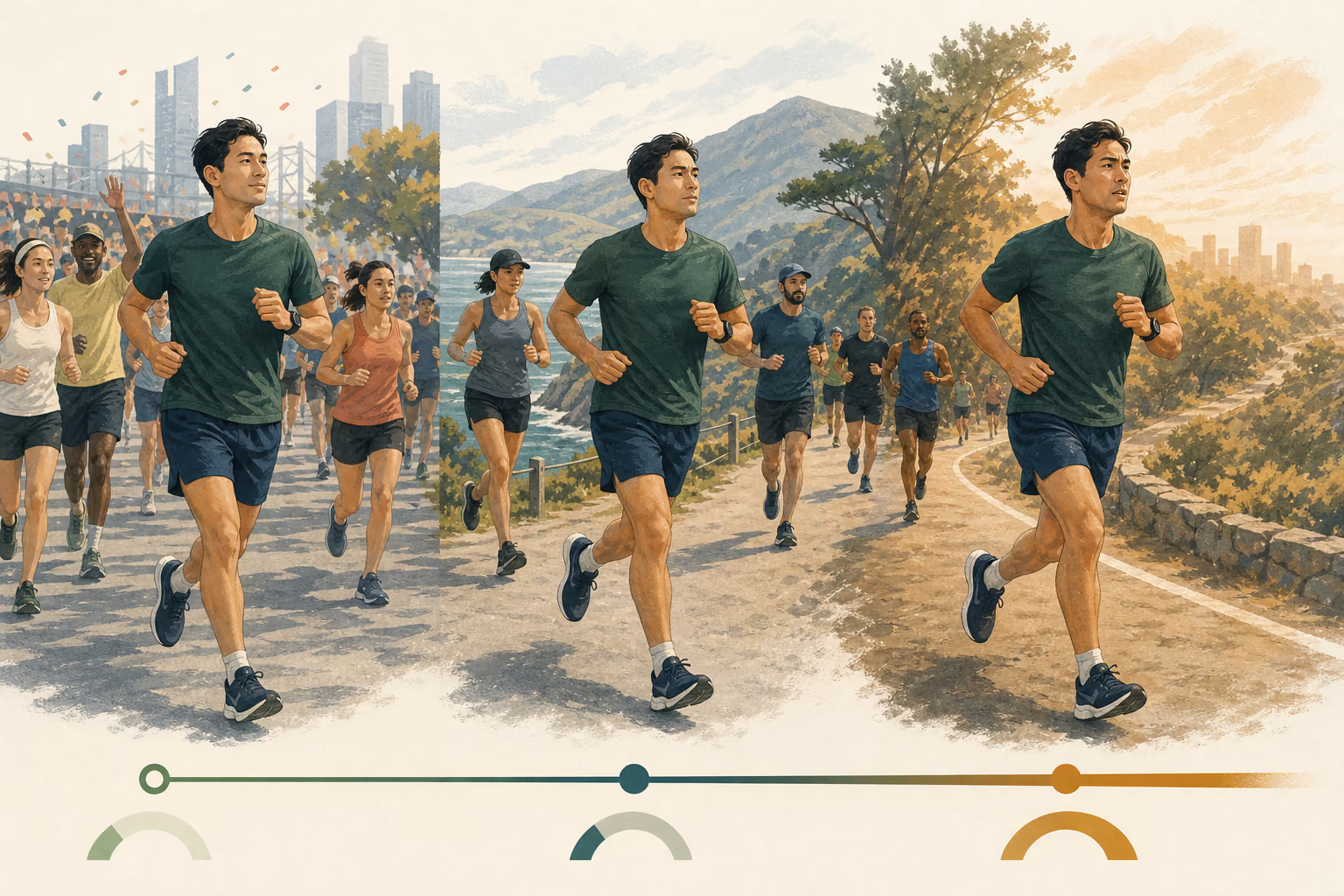
A sound half marathon pace strategy begins slightly below target strain, settles into sustainable race effort through the middle, and reserves any deliberate increase for the final 3–4 miles. Set pace from recent race or training evidence, then adjust it for hills, wind, heat, crowding, and how the effort develops.
Pace is minutes per mile; effort is the cost of producing that pace. Even pacing means relatively stable speed. Even effort allows speed to change with the course. Most road races require both ideas: a pace range on flat calm sections and an effort ceiling when the environment changes.
A negative split means the second half is faster than the first; a positive split means it is slower. Chasing a dramatic negative split can be as unhelpful as banking time early. The practical target is controlled variability—no wasteful opening surge and no pace promise that ignores the course.
No calculator guarantees a finish time. Use the free race-time predictor to create a central estimate and uncertainty range, then keep a conservative plan for a day when training, weather, or health does not support the primary target.
Choose a target from evidence
Recent race result
A recent 5K, 10K, or half marathon can estimate equivalent performance. Longer and more recent races usually require less extrapolation, but equivalent performance assumes distance-specific training and comparable conditions.
Use a predictor range rather than the fastest central estimate. A 5K shows speed and aerobic ability; it does not prove that long-run durability and fueling are ready for 13.1 miles.
Race-specific workouts
Repeated segments near target pace inside a long run can show whether the effort is controlled after accumulated time. One successful workout is evidence, not a guarantee. Review several sessions and their recovery.
If target pace repeatedly turns into threshold effort—sustained hard running with short-sentence breathing—the goal is too aggressive or conditions are raising its cost.
Recent weekly training
Long-run consistency and total volume help support the distance. An observational study of recreational half-marathoners linked higher training volume and longer endurance runs with faster finishes and less pace decline, but it cannot prescribe a universal mileage threshold.
Use your completed block to decide whether the prediction is supported. Do not select a goal from a historic personal best that current training has not approached.
Convert finish goal to average pace
| Finish time | Average pace per mile | Average pace per km |
|---|---|---|
| 1:30 | 6:52 | 4:16 |
| 1:45 | 8:01 | 4:59 |
| 2:00 | 9:09 | 5:41 |
| 2:15 | 10:18 | 6:24 |
| 2:30 | 11:27 | 7:07 |
| 3:00 | 13:44 | 8:32 |
Build primary, conservative, and finish plans
- 1
Set the primary range
Use recent evidence to create a small pace range on flat, calm terrain—not one second-perfect number.
- 2
Set the opening ceiling
Make the first 2 miles slightly slower or lower effort than the central target. Write the exact cue.
- 3
Set the conservative plan
Choose a slower pace or run-walk ratio that still fits the event cutoff. This is the immediate switch for heat, illness recovery, or an unsustainable target.
- 4
Set terrain rules
Allow pace to fall uphill and into wind; avoid chasing the seconds immediately afterward.
- 5
Set the late-race decision
Choose a mile—often 9 or 10—where you may increase effort only if breathing, form, fueling, and conditions remain controlled.
- 6
Set a watch failure plan
Use course clocks, marked miles, elapsed time, perceived effort, and nearby pace groups.
A worked 2:00 pacing plan
| Segment | Illustrative pace | Decision cue |
|---|---|---|
| Miles 1–2 | 9:15–9:25 | Complete-sentence control; no weaving |
| Miles 3–6 | Settle near 9:05–9:12 on flat calm sections | Rhythm feels purposeful, not urgent |
| Miles 7–9 | Hold effort; accept terrain variation | Fuel on schedule; do not repair split |
| Miles 10–12 | Maintain or move toward 9:00 if controlled | Posture and breathing still stable |
| Final 1.1 | Use remaining capacity | Increase only with clear path and controlled movement |
What split-time research suggests
A 2023 analysis examined split times from 133,268 half-marathon finishers at the Vienna City Marathon events. All performance groups showed positive pacing—some slowing—but faster groups had less absolute speed change than slower groups. Half marathon pacing was also more even than marathon pacing.
The study describes finishers rather than assigning strategies experimentally. Faster runners may pace more evenly because they are better trained, more experienced, or selected by other factors. The practical lesson is modest: avoid adding variability you do not need, especially an early surge.
Perfectly even splits are not the goal on a variable course. The evidence comes from recorded segment speeds, while your race includes grade, wind, congestion, and stations. Preserve effort and use broader segment trends rather than treating every mile as a pass/fail test.
Runner scenario
Scenario: Owen's 10K prediction is faster than his training
Owen, aiming for his first sub-1:45 half marathon
A recent flat 10K predicts 1:42. His long runs are consistent, but 3 × 2 miles at 1:45 pace felt controlled only through the first two repetitions. Race day includes several hills.
- The decision
- Owen plans to follow the 1:42 pace group because the calculator represents current fitness.
- Recommended approach
- Use a 1:45–1:48 primary range, start below it, and run hills by effort. Keep 1:42 as future evidence rather than opening pace. Reassess after mile 10 if the controlled range feels sustainable.
- Why
- The shorter race demonstrates aerobic speed, while the incomplete specific workout and course reduce confidence in the direct equivalence. A range integrates more evidence than the fastest prediction alone.
Race hills without destroying the average
Uphill
Let pace slow while perceived effort rises only modestly. Shorten stride and keep cadence comfortable. A twenty-second slower uphill mile does not require a twenty-second sprint on the descent. For course-profile analysis and downhill mechanics, use the hilly half marathon guide.
Hold effort briefly over the crest before resuming rhythm. Surging at the top often extends the hill's cost into the next segment.
Downhill
Use gravity through quick balanced steps and relaxed posture. Do not overstride or brake sharply. The fastest safe pace is the one practiced for that grade and surface.
Crowding can remove the ideal line. Prioritize predictable movement over passing several runners on a turn.
Pace in heat, wind, and rain
Heat
The same pace costs more as heat and humidity rise. Begin by effort below the original clock target and accept that a meaningful race may require changing the time goal.
Do not use a universal seconds-per-mile adjustment as medical protection. Follow official guidance, cooling options, and an individualized hydration plan.
Wind
Use effort into a headwind and avoid fighting for instant pace. A legal group can reduce exposure, but do not crowd or surge repeatedly between packs.
A tailwind may assist pace while reducing convective cooling. Keep the weather plan active even when the watch looks favorable.
Rain
Rain may cool the air but make turns, paint, metal covers, and clothing less predictable. Slow where footing requires it and use the tested anti-chafe and kit plan.
Do not chase time lost to a cautious turn. A safe two-second adjustment preserves the race.
Watch metrics that help instead of command
Elapsed time
The stable anchor for fuel, overall progress, and a no-GPS fallback.
Lap pace
More useful than jumpy instant pace when each official mile is manually lapped.
Average pace
Helpful across long flat segments, but distorted by GPS distance and early congestion.
Heart rate
Context for a runner who knows their data; heat, caffeine, nerves, and drift can change it. Do not chase a zone detached from effort.
Perceived effort
The integrated signal that travels across terrain and weather. Define it in training before relying on it.
Fix pacing problems while they are still small
| Problem | Immediate action | Avoid |
|---|---|---|
| First mile 20 sec too fast | Ease back gradually over the next mile | Abrupt braking or panic |
| GPS loses signal | Use effort, elapsed time, and official markers | Accelerating to repair displayed pace |
| Pace group pulls away uphill | Hold planned effort and reconnect only gradually | Crest sprint |
| Goal effort feels hard by mile 4 | Switch to conservative plan now | Waiting until mile 10 |
| One slow aid-station split | Resume rhythm without surge | Skipping later fuel to save time |
| Feeling strong at mile 7 | Maintain until planned decision point | Starting the final push six miles early |
Run-walk and pace groups
Run-walk average pace
Calculate pace from total elapsed time, including walks. A 12:00 running pace does not create a 12:00 average when one minute of each four is walked.
Rehearse the ratio and use the average from long runs to check the cutoff. Begin walks from the start and resume without sprinting.
Pace groups
Ask whether the leader aims for even pace, even effort, or banked time, and whether the group walks stations. The sign on the stick is not the complete strategy.
Leave the group when its effort is wrong. It is a tool, not an obligation or guarantee.
Use official mile markers to correct watch error
Manual-lap the course
Press the lap button at each official mile marker when it is safe to do so. The completed lap shows how long that course mile took even when the watch has measured 1.03 or 0.97 miles. Read the trend across several markers rather than reacting to one misplaced sign or crowded turn.
Do not weave across runners to hit the button exactly. A few seconds of delay can be interpreted; a collision cannot. Elapsed time remains the fallback if manual laps become distracting.
Calculate clock position, not only pace
For a 2:00 goal, halfway is roughly 1:00 before accounting for where the official timing mat sits and how the strategy handles the opening. A runner can write broad checkpoint ranges at 5K, 10K, and 10 miles rather than perform arithmetic under fatigue.
Checkpoint time should trigger a decision only with effort and course context. Being twenty seconds behind after a hill or station is not a command to sprint. Being exactly on time while breathing has become urgent may still require the conservative plan.
Runner scenario
Scenario: Tasha has no reliable time prediction
Tasha, a run-walk runner completing her first half marathon
Her longest outing was 11 miles using four minutes running and one minute walking. Pace varied by terrain, and her priority is finishing comfortably inside the event cutoff.
- The decision
- Tasha searches for one goal pace because she believes every race strategy must begin with a predicted finish time.
- Recommended approach
- Build the strategy from the rehearsed 4:1 ratio, long-run elapsed average, the official cutoff, and an opening conversational-effort ceiling. Walk from the first scheduled interval, fuel by elapsed time, and use course clocks to confirm a comfortable cutoff margin without accelerating after each walk.
- Why
- Her training evidence supports a process more clearly than a second-perfect pace. Starting the walks immediately prevents early excitement from changing the method that made the distance manageable, while elapsed averages still provide practical course timing.
Make late-race decisions from four signals
| Signal at mile 9 or 10 | Decision | Reason |
|---|---|---|
| Breathing controlled, form stable, fuel on plan | Increase effort gradually | Multiple systems support the move |
| Feeling excited but pace already drifted fast | Hold current effort | Emotion is not unused capacity |
| Legs heavy, breathing controlled | Maintain or make a small conservative adjustment | A sudden surge may damage form without creating durable speed |
| Breathing urgent or form deteriorating | Switch to conservative pace or ratio | The primary plan is no longer sustainable |
| Concerning symptom or gait-changing pain | Stop and seek appropriate help | This is not a pacing puzzle |
Write your pacing card
- 1
Choose the evidence
Use recent race, workouts, and completed long-run training—not aspiration alone.
- 2
Set ranges by segment
Write opening ceiling, middle flat-course range, and late-race decision point.
- 3
Add course rules
Specify hills, wind, aid stations, and run-walk transitions.
- 4
Add the conservative plan
Choose the pace or ratio that meets the cutoff and preserves a controlled race.
- 5
Use the predictor in context
Feed a realistic range into the race-specific personalized plan and keep conditions and preparation visible.
Put it into a plan
Turn this guidance into your next useful step.
Use a free resource to explore your options, or build a race-specific plan around your date, availability, and current fitness.
Predict your race timeKeep learning
Related resources
Half marathon time predictor
Turn a recent performance into a realistic half marathon prediction.
Read guideHilly Half Marathon Strategy
Train and race a hilly half marathon by using effort, controlled climbing, relaxed descents, and course-specific preparation.
Read guideHalf Marathon Weather Strategy
Prepare for heat, cold, rain, and wind in a half marathon by adapting effort, clothing, fluids, and expectations to race-day conditions.
Read guideQuestions runners ask
- What pace should I run a half marathon?
- Use recent race performance, specific workouts, and long-run consistency to set a range. Start slightly below target strain, then settle on flat sections. A prediction from a short race assumes suitable endurance training and comparable conditions, so keep a conservative plan.
- Should I aim for even splits or a negative split?
- Aim for controlled early effort and limited pace variation rather than a dramatic negative split. A slight negative split may result on a flat favorable day. On hills or in wind, even effort matters more than identical clock splits.
- How slow should the first mile be?
- Often 5–15 seconds per mile slower than central target is enough for a time-goal runner, while beginners may use an effort cue instead. Congestion can make it slower. The key is avoiding target-plus excitement, not hitting one prescribed delay.
- Can I bank time early?
- Banking time spends energy early at a higher cost and often produces later slowing. Begin controlled and let favorable terrain create small natural gains. Do not intentionally run above sustainable effort to insure against the final miles.
- When should I speed up?
- Use a preselected point around mile 9 or 10, then assess breathing, posture, conditions, fueling, and whether pace has remained controlled. Increase effort gradually. Feeling good at mile 6 is not evidence to begin a seven-mile finish.
- What if I cannot hold goal pace in the race?
- Switch to the conservative plan early. Reduce pace or use the rehearsed run-walk ratio, keep fueling, and stop trying to regain time through surges. Concerning symptoms require medical support, not a pacing adjustment.
- Why does my watch show more than 13.1 miles?
- GPS error and running a wide line around turns add displayed distance. Follow the measured course and official markers. Use manual laps and elapsed time rather than accelerating because the watch's average pace no longer matches.
Sources and methodology
This guide is educational, not medical advice. It is written from general training principles and linked primary or official references; use judgment for your own conditions and consult a qualified professional for individual health concerns. Read our editorial methodology.
- ACSM's Guidelines for Exercise Testing and Prescription — American College of Sports Medicine. General exercise-training principles and progression guidance.
- Physical Activity Basics — Centers for Disease Control and Prevention. Public-health guidance on physical activity and its role in health.
- The pacing differences in performance levels of marathon and half-marathon runners — Frontiers in Psychology. Observational split analysis of 208,760 finishers in which better-performing runners showed more even pacing; the design does not prove pacing caused performance.
- Training volume and longest endurance run related to performance and running injuries — Scandinavian Journal of Medicine & Science in Sports. Observational study of recreational half-marathon and marathon runners.
- Road Running — World Athletics. Background on road-racing disciplines and race-day conditions.