Half marathon guide
Run-Walk Half Marathon Training
Run-walk training is a legitimate way to prepare for a half marathon. Planned walk breaks can help you control effort, practice longer sessions, and keep early training approachable; use intervals that make the full session repeatable rather than treating walks as failure.
The short answer
Run-walk training is a legitimate way to prepare for a half marathon. Planned walk breaks can help you control effort, practice longer sessions, and keep early training approachable; use intervals that make the full session repeatable rather than treating walks as failure.
Run-walk is a pacing method, not a rescue plan
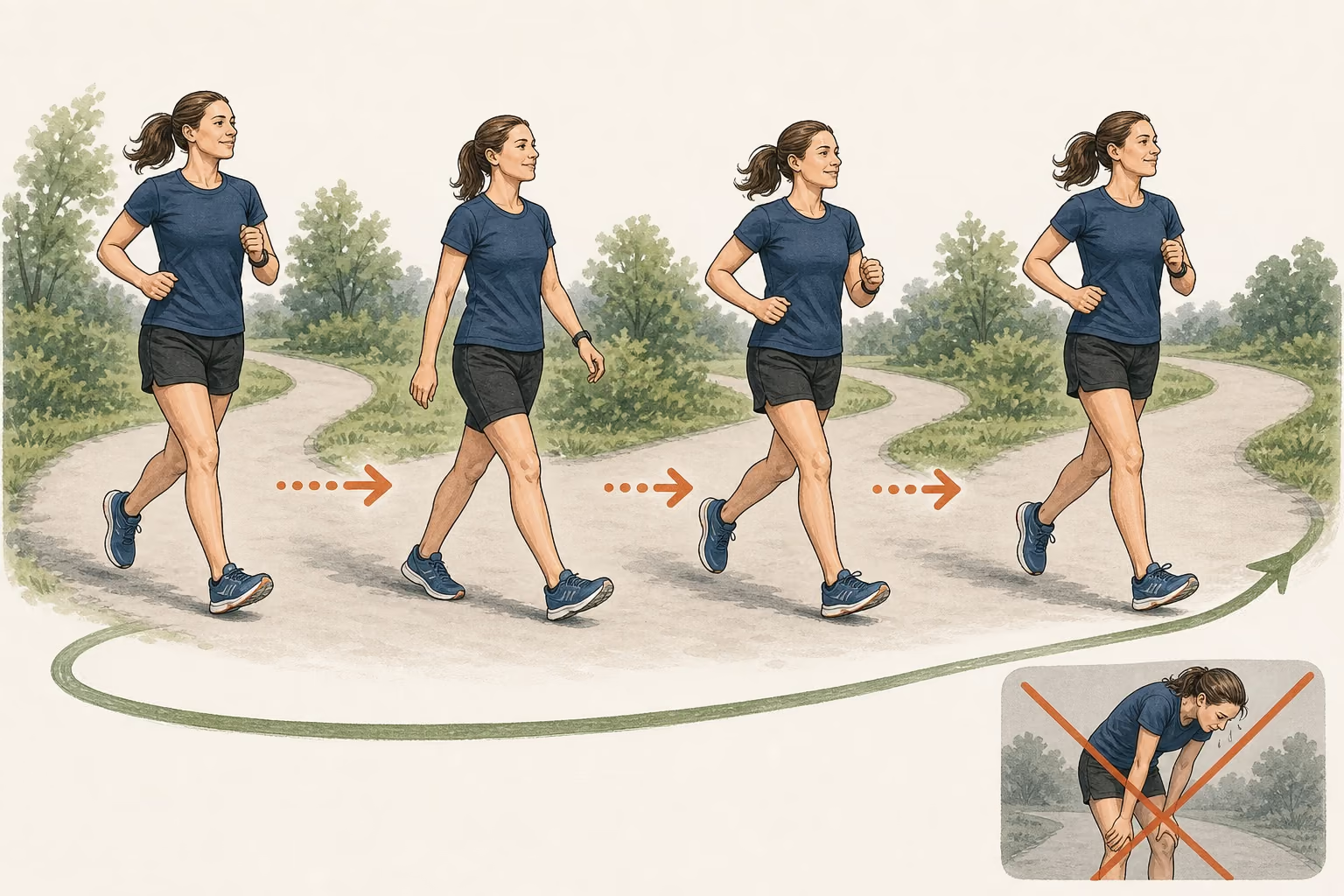
Run-walk half marathon training alternates planned periods of easy running with purposeful walking. The walk begins according to the schedule, before exhaustion makes the decision for you. Used that way, it can control early effort, make long sessions more approachable, and create predictable moments for drinking or taking fuel.
The method is not only for people who are unable to run continuously. Some runners choose intervals from the first mile through the finish because the pattern helps them pace. Others use run-walk while building fitness and later move toward continuous running. The best version is the one you can rehearse and execute without repeated surges.
An interval is written as run time followed by walk time: 3:1 means three minutes of running and one minute of walking. It does not prescribe pace. The running portion should usually feel controlled enough that you could continue past the timer; the walk should be brisk but restorative rather than a complete stop.
Run-walk does not remove the need for gradual training. Total time, total distance, running pace, and the ratio itself all contribute to workload. Change one main variable at a time so you can tell whether the new pattern remains repeatable.
What the intervals change—and what they do not
They can lower the cost of each running bout
A short walk allows breathing and local muscular effort to settle before the next run segment. That can make the overall session feel more controlled than running until a forced stop. The benefit depends on keeping the running portions easy; sprinting between walks defeats the design.
The transition also interrupts the tendency to accelerate unconsciously. A timer reminds you to check posture, relax your hands, and begin the next run without chasing lost seconds.
They do not make distance free
A two-hour run-walk is still a two-hour endurance session. Feet, legs, fueling, weather, and recovery remain relevant. Planned walks can make the work manageable, but they do not justify large jumps in total duration.
Measure progress across the week. If a longer run-walk removes the next two sessions, shorten it or hold the duration until recovery improves.
They do not have to disappear
Continuous running is one possible outcome, not the graduation ceremony. If your goal is to complete the race comfortably under the cutoff, a practiced ratio may remain the best strategy.
If you want to run continuously, lengthen selected run segments only after the current pattern is stable. Keep the walk available as a tool rather than treating its use as failure.
Choose a starting ratio by control, not pride
| Pattern | Useful starting situation | What to watch |
|---|---|---|
| 30 sec run / 90 sec walk | First exposure to running or return after a long inactive period | Run slowly despite the short bout; avoid sprinting |
| 1 min run / 1 min walk | New runner who can repeat short controlled efforts | Keep all run bouts similar, including the last |
| 2 min run / 1 min walk | Runner with a small base who wants regular resets | Do not shorten walks to protect an arbitrary pace |
| 3 min run / 1 min walk | Established run-walker building longer sessions | Begin walks on schedule before breathing is ragged |
| 5 min run / 1 min walk | Runner near continuous easy running who still values planned breaks | The run should not turn into a five-minute time trial |
| Aid-station walking | Continuous runner practicing purposeful race breaks | Stations may be crowded; rehearse slowing before grabbing a cup |
Find your ratio in three sessions
- 1
Pick the conservative option
Start with a ratio you believe you can repeat for the entire planned duration. A 1:1 or 2:1 pattern is more informative than an ambitious interval that fails halfway.
- 2
Keep the run pace conversational
Use complete-sentence breathing and relaxed posture. If you race each run segment, a longer walk merely repairs a pacing error.
- 3
Use a quiet timer
Set vibration or a low-volume alert before leaving. Practice the controls so you are not staring at the watch or phone at every transition.
- 4
Record the final third
Note whether form, breathing, and pace remain similar near the end. The correct ratio is judged after the novelty has worn off.
- 5
Repeat it unchanged
Use the same ratio in a second comparable session. One run can be distorted by weather, route, sleep, or excitement.
- 6
Adjust one piece
If both sessions were controlled, add a small amount of total time or lengthen selected runs. If not, slow the running or lengthen the walks before changing duration.
Three run-walk workouts with different jobs
Intervals are the delivery method; the workout's purpose still determines duration and effort.
Easy routine builder
Accumulate controlled aerobic movement and make the transitions automatic.
- Structure
- 5 minutes walking, then 10–12 rounds of 2 minutes easy run / 1 minute brisk walk, then 5 minutes easy walking.
- Effort
- 3–4 out of 10 during runs; breathing settles quickly during walks.
- Recovery
- The next day can be rest, walking, or another low-load activity.
- Progression
- Add one or two rounds after the pattern has been repeated successfully.
Long run-walk
Practice time on feet, route management, and the race-day ratio.
- Structure
- Use the familiar ratio from the first minute for the planned easy duration. Walk an extra 20–30 seconds when taking fuel if needed; resume without surging.
- Effort
- Conversational throughout. Hills may be walked regardless of the timer.
- Recovery
- Protect at least one low-load day and review how the rest of the week is affected.
- Progression
- Increase duration modestly, then repeat. Do not make the run intervals faster as the route grows.
Controlled steady intervals
For established run-walkers, practice a slightly firmer but sustainable rhythm.
- Structure
- After an easy warm-up, complete 4–6 rounds of 4 minutes steady run / 2 minutes easy walk, then cool down.
- Effort
- About 5–6 out of 10 during the steady segments; never breathless or racing.
- Recovery
- Place easy or rest days around the session; skip it in early base training.
- Progression
- Add one round before changing pace, and keep long runs easy that week.
How to calculate likely race pace with walks included
Your average pace is not the running pace. It combines run segments, walk segments, aid-station delays, turns, hills, and any stops. To estimate it, rehearse the full ratio on a long easy session and use the total elapsed time—not only moving time—divided by distance. Then use the race-pace strategy guide to turn that average into conservative opening, primary, and fallback plans.
For example, a runner may cover 6 miles in 1 hour 24 minutes using 3:1 intervals. The elapsed average is 14:00 per mile. That is more useful for checking a cutoff than the 12:30 pace displayed during the run portions. Add margin because a crowded race and later miles can slow transitions.
If the official limit is 3 hours 30 minutes, the simple overall threshold for 13.1 miles is roughly 16:02 per mile. Intermediate checkpoints may be stricter, and the clock may start at the gun rather than when you cross the line. Read the organizer's exact rule rather than relying on the final cutoff alone.
Do not train every long run at the fastest average that meets the cutoff. Early preparation should build the routine at easy effort. If your conservative rehearsed pace remains outside the limit, choose a more generous event or allow more preparation instead of turning all training into a race.
Runner scenario
Scenario: Kim keeps speeding up after every walk
Kim, a first-time run-walk racer
She uses 4 minutes running / 1 minute walking. Her easy continuous pace is around 12:45 per mile, but she runs the intervals near 11:00 because each walk makes her feel behind.
- The decision
- By mile 5 of long runs, she extends the walks and feels that the method has failed.
- Recommended approach
- Slow the run segments to conversational effort, keep the walk brisk, and hide instant pace from the watch. Use lap or overall elapsed pace only after the session. If necessary, begin with 3:1 until the transitions stay smooth.
- Why
- The walk is not causing the breakdown; the repeated surges are. A stable run pace lets the planned recovery do its intended job and produces a more reliable average.
Use run-walk on hills, at aid stations, and while fueling
Hills
Walk a steep hill when running would push effort well above the session's purpose, even if the timer says run. Shorten your stride before the grade, shift to a purposeful walk, and resume only after the crest when breathing is controlled.
Downhills are not free recovery. Avoid sprinting to win back time; stay balanced and let pace come from the grade without overstriding.
Aid stations
If you plan to walk through aid stations, practice the sequence: signal and move to the side, ease down before the table, take the cup, drink without choking, dispose of it in the marked area, and resume gradually. Sudden stops in the center create collisions.
Aid stations rarely align perfectly with a timed interval. Treat the station walk as the scheduled break, then restart the ratio after it rather than taking two immediate walks.
Fuel
A planned walk can make a familiar gel or chew easier to take. Practice timing and fluids on long runs. The ratio does not determine carbohydrate needs; total duration, tolerance, and conditions still matter. Build the arithmetic and rehearsal sequence with the half marathon fueling guide.
Sports nutrition guidance provides general starting ranges, not a personalized prescription. Persistent gastrointestinal problems, diabetes, or other medical nutrition concerns require qualified individual support.
Fix the most common run-walk problems
| Problem | Likely cause | Adjustment |
|---|---|---|
| Walks keep getting longer | Run segments are too fast or ratio is too ambitious | Slow the run first; then choose a shorter ratio |
| Calves tighten at every restart | Abrupt acceleration or stride change | Resume gradually with short steps; keep the walk purposeful |
| Timer creates anxiety | Too many alerts or attention fixed on the watch | Use vibration, a simpler ratio, or landmarks on a familiar loop |
| Overall pace is inconsistent | Surging after walks and on downhills | Target even effort and review elapsed pace after the session |
| Walking feels like stopping | Walk pace drops completely | Keep arms active and use a brisk sustainable walk |
| Crowds block transitions | Abrupt changes in the main line | Signal, move predictably to the side, and transition gradually |
When and how to move toward continuous running
First confirm the reason
Change because continuous running supports your goal or feels preferable—not because walking seems illegitimate. A run-walk finish is still a half marathon finish.
Extend selected intervals
Keep most of the session familiar and lengthen every second or third run segment. This exposes you to longer running without changing the whole workout.
Hold total duration steady
If the running share increases, do not also make the session longer that week. The ratio change already raises the demand.
Preserve optional walks
Use hills, aid stations, or scheduled checkpoints as walking opportunities. Removing every break at once is not required.
Return to the prior pattern when needed
Heat, hills, fatigue, or a longer route may make the established ratio the better tool. Flexibility is competent pacing, not regression.
Make the transitions physically quiet
From run to walk
Glance behind when others are nearby, signal or move gradually to the side, and shorten your running stride before walking. Do not plant the feet and stop abruptly. Keep the arms moving and settle into a brisk cadence that preserves forward momentum.
Use the first seconds to release tension in the jaw, shoulders, and hands. Check breathing without turning the break into a repeated body scan. The goal is to begin the next run composed, not to force every sensation to disappear.
From walk to run
Resume with ten or fifteen short easy steps. The alert is permission to run, not a starter pistol. Accelerating hard changes mechanics and spends the recovery you just created.
Aim for the same effort as the previous run segment. On a hill or into wind, that may mean a slower pace. If breathing becomes uncontrolled within the first minute, slow down or select a shorter run interval rather than extending the next walk indefinitely.
Through crowded spaces
At race starts, the ideal line may be unavailable. Begin in an appropriate corral, keep your movement predictable, and avoid weaving to preserve a target pace. If the first scheduled walk arrives in dense traffic, move gradually toward the edge before it begins.
Do not run on the far outside for the entire course without checking event guidance; turns and closed-lane arrangements differ. Courtesy is predictable change, not choosing one universal side.
A run-walk race plan by course segment
| Segment | Execution cue | Adjustment rule |
|---|---|---|
| Start to mile 2 | Use the rehearsed ratio immediately; run below excitement | Ignore runners passing; do not lengthen runs because you feel fresh |
| Early middle | Settle into automatic transitions; take familiar fuel as planned | Treat aid-station walk as the scheduled break |
| Hills or wind | Protect effort; walk steep grades regardless of timer | Resume only when posture and breathing are controlled |
| Mile 8–10 | Review form, fuel, and effort without judging the whole race | Keep ratio; shorten run only if needed—do not surge |
| Final 5K | If controlled, maintain or modestly lengthen selected runs | Change one interval at a time; return to pattern if effort spikes |
| Finish approach | Run only as strongly as balance, space, and control allow | A sprint is optional and should not create unsafe weaving |
How to practice without becoming dependent on perfect timing
The timer teaches rhythm, but races interrupt clocks. A hill begins with thirty seconds left in a run, an aid station appears during a walk, or a crowded turn delays the transition. Practice a hierarchy: course safety first, effort second, timer third. Resume the pattern after the interruption instead of trying to repay seconds.
On one easy run, use landmarks rather than alerts—run to the second light pole, walk to the next—or deliberately delay a transition by a few seconds to navigate a crossing. This is not a harder workout. It rehearses adaptability while preserving the overall ratio and effort.
Keep manual control available. Know how to silence or restart alerts, and have a simple backup such as walking for roughly one minute after every song marker, mile sign, or aid station. Technology should cue the strategy, not own it.
Build your run-walk plan
- 1
Select the ratio
Choose the most conservative pattern that fits your current controlled running.
- 2
Test it twice
Use comparable easy sessions and review the final third, not only the beginning.
- 3
Check the race cutoff
Use elapsed average pace with margin and verify intermediate checkpoints.
- 4
Put it into the long run
Start the ratio immediately, practice hills and aid-station transitions, and use familiar fuel.
- 5
Choose the next change
Adjust one of ratio, total time, or pace. A race-specific personalized plan can organize the progression around your available days and event date.
Put it into a plan
Turn this guidance into your next useful step.
Use a free resource to explore your options, or build a race-specific plan around your date, availability, and current fitness.
Build your plan for $19.99Keep learning
Related resources
Couch to Half Marathon: A Realistic Starting Guide
Learn how to build from little or no running toward a first half marathon with a longer, beginner-friendly runway.
Read guideYour First Long Run: A Beginner’s Guide
Prepare for your first half marathon long run with easy effort, route planning, fueling practice, and a manageable progression.
Read guideHalf Marathon Race Pace Strategy
Build a half marathon race pace strategy with a realistic opening effort, controlled adjustments, and practice from training runs.
Read guideQuestions runners ask
- What is the best run-walk ratio for a half marathon?
- There is no single best ratio. Choose one that keeps the final third of long runs as controlled as the first: 1:1, 2:1, or 3:1 are practical starting experiments. The running pace matters as much as the clock. Test the same ratio at least twice before changing it.
- Should I walk from the beginning or wait until I am tired?
- Walk from the beginning if run-walk is your strategy. Early planned breaks control effort and make the pattern automatic. Waiting until exhaustion turns walking into a response to poor pacing and makes later intervals harder to predict.
- Can run-walk be faster than continuous running?
- For some runners, controlled breaks produce a steadier overall effort than starting continuously and slowing dramatically. That does not guarantee a faster time. Compare elapsed average pace and recovery in rehearsals rather than assuming the method will create a specific result.
- Do walking breaks count in my training mileage?
- Yes, the full session distance and duration contribute to the endurance load. Record both elapsed time and the ratio so the context is clear. Do not add extra miles because part of the session was walked.
- How do I stop my watch from ruining the rhythm?
- Use vibration alerts and display elapsed time or heart rate instead of instant pace. Practice starting, pausing, and ending the workout before race day. If alerts increase anxiety, use a simpler ratio or physical landmarks on a familiar route.
- Can I change ratios during the race?
- Yes, but make changes deliberately. Keep the rehearsed pattern early, walk steep hills or crowded aid stations when useful, and lengthen walks if conditions raise the effort. Avoid making run segments faster to compensate; protect a stable overall effort.
- Will people get in my way—or will I get in theirs?
- Predictable movement solves most crowd problems. Start in an appropriate corral, keep to one side where event guidance allows, glance and signal before slowing, and avoid stopping abruptly in the center. Practice gradual transitions so they feel automatic.
Sources and methodology
This guide is educational, not medical advice. It is written from general training principles and linked primary or official references; use judgment for your own conditions and consult a qualified professional for individual health concerns. Read our editorial methodology.
- ACSM's Guidelines for Exercise Testing and Prescription — American College of Sports Medicine. General exercise-training principles and progression guidance.
- Physical Activity Basics — Centers for Disease Control and Prevention. Public-health guidance on physical activity and its role in health.
- Training volume and longest endurance run related to performance and running injuries — Scandinavian Journal of Medicine & Science in Sports. Observational study of recreational half-marathon and marathon runners.
- Exercise and Fluid Replacement — American College of Sports Medicine. Position stand on hydration during exercise.
- Nutrition and Athletic Performance — American College of Sports Medicine, Academy of Nutrition and Dietetics, and Dietitians of Canada. Joint position statement on sports nutrition.