Editorial
How to Set a Better Half Marathon Goal
A useful half marathon goal includes more than a finish-time number. It links a performance target to your current training, the course, and the process you control. A range and a race-day effort plan are usually more useful than one exact split that assumes a perfect day.
The short answer
A useful half marathon goal includes more than a finish-time number. It links a performance target to your current training, the course, and the process you control. A range and a race-day effort plan are usually more useful than one exact split that assumes a perfect day.
A half-marathon goal should be a decision policy, not one exact time
The most useful half-marathon goal tells you what to do in training, how to start the race, and how to adjust when the day differs from the forecast. One exact finish time cannot do all three. It assumes your current fitness is known precisely, the course is neutral, the weather cooperates, and the first miles unfold without congestion or excitement.
Build the goal in layers: a process commitment you control, a performance range supported by current evidence, and a race-day effort policy for heat, hills, wind, or an unexpectedly difficult opening. The finish time remains motivating, but it becomes one outcome inside a system rather than a command that survives every condition.
Prediction research in recreational runners shows why ranges matter. Models can be useful up to the half-marathon, yet individual error remains. Studies also often rely on male cohorts, self-reported training, or variables unavailable to an everyday runner. A calculator gives a central estimate; it does not remove uncertainty. Your goal should acknowledge that before race morning forces the lesson.
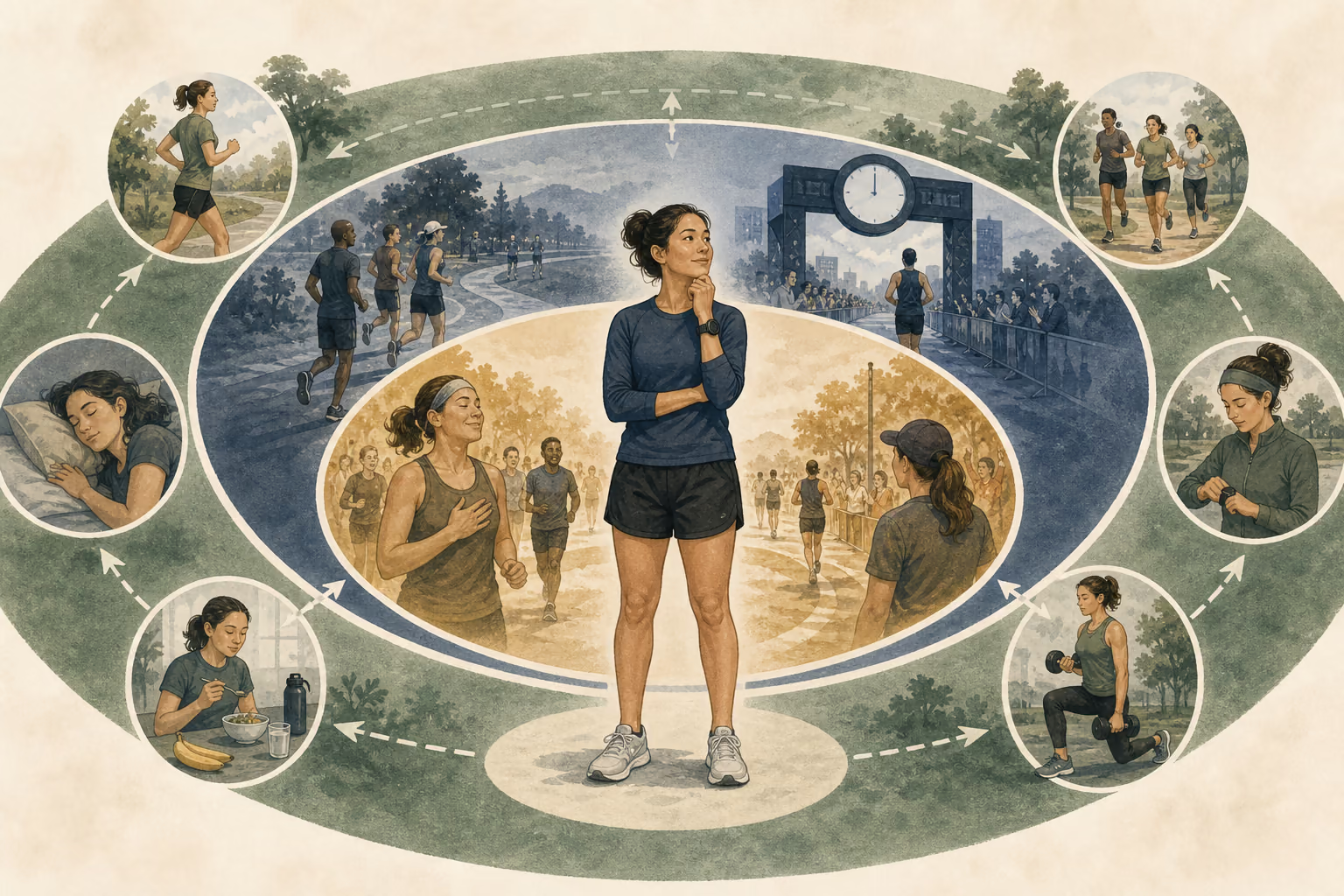
The four jobs a good goal performs
Selects the training level
The target should help choose paces and specificity without making the goal itself proof of current fitness. Use a recent result to set training; use training to evaluate the goal.
Directs controllable behavior
A process goal turns ambition into actions: run on three dependable days, keep easy days conversational, practice fuel on long runs, or complete a bedtime routine before key sessions.
Defines the desired race experience
An experience goal names how the runner wants to respond: patiently, attentively, and willing to revise a time demand when the day changes. The race-pace strategy guide owns the segment-by-segment execution plan.
Protects meaning when conditions change
A conditions-based fallback lets the race remain successful when heat, wind, or hills make the central time inappropriate. Adaptation is not surrender; it is part of a defensible goal.
Build one goal in four layers
| Layer | Question | Example | Evidence |
|---|---|---|---|
| Process | What will I do most weeks? | Run four days, preserve two easy days | Calendar and recent habit |
| Preparation | What must become familiar? | Long-run duration and practiced fuel | Completed training, not plan intent |
| Performance range | What outcomes fit current evidence? | 1:52–1:57 in ordinary conditions | Recent race plus training response |
| Experience | How do I want to respond? | Patient opening; deliberate decisions when conditions change | Values, course, and rehearsal |
Choose evidence that resembles the race you are planning
A recent 10K is often a useful anchor because it combines speed and sustained effort. A 5K can set faster training paces but may overstate half-marathon readiness for a runner without long-run history. A previous half marathon is highly specific when fitness, course, and conditions remain comparable.
Use the free VDOT calculator or race-time predictor to translate the result, then keep the source attached: distance, date, course, weather, pacing, and whether the effort was representative. A 10K personal best on a cool flat course means something different from an untapered trail race in heat.
Avoid lifetime bests after a long gap. Goal setting is not a vote on your potential; it is a decision about this block. Use current evidence, and let later training earn a revision.
Turn a predicted time into a realistic range
- 1
Generate the central estimate
Use a recent representative race in the predictor. Save the input and the predicted range, not only the most attractive number.
- 2
Apply distance readiness
Check weekly consistency, longest recent run, and whether race-pace work stays below threshold effort. Short-race speed without endurance widens uncertainty.
- 3
Apply course cost
Review official elevation, surface, turns, and likely congestion. Do not invent an exact hill conversion; adjust the range and race policy.
- 4
Apply weather uncertainty
Keep the central range for ordinary conditions and write an effort fallback for heat, wind, rain, or cold.
- 5
Choose a central and stretch outcome
The central outcome should fit current evidence. A stretch is available only if conditions and early effort are favorable.
- 6
Name the experience goal
Write how you want to respond to early excitement and changing conditions. Build the detailed segment plan in the race-pace strategy guide.
Runner scenario
Scenario: Nora's calculator says 1:49, but her training says “not yet”
Nora
A 37-year-old runner with a recent 23:30 5K, averaging 18 miles per week and a longest recent run of 7 miles. Her half marathon is hilly and 10 weeks away.
- The decision
- A calculator's equivalent time becomes Nora's 1:49 goal. She runs race-pace blocks at 8:19 per mile, but they feel like threshold by ten minutes. She assumes the discomfort proves the workouts are effective.
- Recommended approach
- Use the 5K to calibrate short workouts, not to certify the half-marathon equivalent. Set a provisional 1:55–2:02 range, build long-run duration, and reassess after a 10K or controlled longer race-pace session. Race hills by effort and keep 1:49 as a future possibility, not the current opening command.
- Why
- Nora's speed evidence is strong; her distance-specific evidence is thin. A wider range preserves ambition while preventing a short-race equivalence from turning every specific session into threshold work.
Treat the goal as a hypothesis that training can update
A goal set 16 weeks out should not carry the same confidence six weeks later without review. Training adds evidence: weekly frequency, long-run response, threshold control, race-pace rehearsal, and tune-up results. It also reveals constraints such as heat, missed weeks, and limited recovery.
Schedule two review points. The first occurs after enough consistent training to judge whether the opening assumptions fit. The second occurs before the taper, when fitness-building work is mostly complete. A review can confirm, narrow, widen, or lower the range. None of those outcomes changes your worth or makes earlier work useless.
Do not update from one exceptional workout. Tailwind, group pacing, extra recovery, or a short repetition can make a split look like race evidence. Require convergence: several weeks of stable training plus a representative continuous effort or specific session.
Which evidence should change the goal?
| Evidence | Weight | Why | Common misuse |
|---|---|---|---|
| Recent measured 10K | High | Continuous representative effort | Ignoring course or weather |
| Previous half marathon | High when recent/comparable | Distance-specific pacing and durability | Using an old lifetime best |
| Long-run race-pace blocks | Moderate | Specific control after duration | Treating one session as a guarantee |
| Short intervals | Low for finish prediction | Show faster rhythm, not continuous endurance | Projecting rep pace to 13.1 miles |
| Easy-run average | Low | Affected by conditions and purpose | Using faster easy pace as proof |
| Missed training pattern | High for readiness | Changes preparation completed | Pretending planned mileage occurred |
Goal pace is not automatically training pace
Training paces should come from current performance. A goal can guide later race-specific work only after it becomes plausible. Entering a desired finish time into a calculator and using the output as present fitness reverses the logic: the ambition manufactures the evidence.
If goal pace repeatedly feels like threshold during short controlled blocks, slow it or shorten the session and reassess. Half-marathon effort should become demanding through duration, not feel like a 10K race from the opening minutes.
Separate “practice the rhythm” from “prove the goal.” A small amount of aspirational pace can be used carefully by an experienced runner, but it should not dominate the week or require recovery that displaces more relevant training.
Course and weather change goal confidence before they change execution
Hills reduce direct comparability
A flat-course prediction carries less confidence on a rolling course. Widen the time range or make it explicitly conditional, then use the hilly-race and race-pace guides to decide how climbs and descents change execution.
Heat and humidity widen uncertainty
Do not invent one universal seconds-per-mile penalty. Mark the central time as ordinary-conditions evidence, retain the process and experience goals, and use the weather strategy guide for race-day adjustments.
Wind increases split variability
A single target split becomes less informative when direction and exposure change. The goal can remain ambitious while its success definition includes responsiveness; the pacing guide owns how effort is distributed.
Congestion changes confidence in exact time
A crowded start introduces uncertainty the predictor cannot price precisely. Record it as a course assumption rather than pretending the same central estimate has minute-level certainty.
Good conditions make the stretch plausible, not compulsory
A favorable forecast can support the stretch layer without rewriting the entire goal. The goal article stops at that decision; the race-pace strategy guide determines when an execution change is justified.
A, B, and C goals fail when they are only three finish times
Three times can create a hierarchy where anything below A feels like loss. Build different functions instead. A is the stretch performance available under favorable conditions and strong late-race control. B is the central performance range supported by evidence. C is an execution goal that survives difficult conditions.
A useful C goal might be: remain patient early, respond to the course rather than the watch alone, use the rehearsed routine, and make deliberate decisions when conditions change. It is not a consolation prize. The race-pace strategy guide turns that experience goal into segment cues.
Add a completion decision when preparation time is short. If the goal shifts from racing to finishing, say so before the start and use run-walk, adjusted pace, or a later event as appropriate. Do not retain race-level intensity language around a completion-level preparation block.
A sample goal card
| Field | Written decision |
|---|---|
| Current evidence | Recent flat 10K, 52:00, even splits, cool conditions |
| Training process | Four runs weekly; long run Sunday; fuel practice every other long run |
| Central range | 1:55–2:00 in ordinary conditions |
| Stretch | Approach 1:53 only when conditions and late-race control support it |
| Experience | Patient early; responsive rather than anxious when splits vary |
| Revision rule | Widen or shift the range when preparation or conditions change materially |
| Execution handoff | Build segment cues in the half-marathon race-pace strategy guide |
Prediction accuracy is personal, not merely mathematical
A study of 7,211 half-marathon runners examined how accurately runners predicted their own finish times and found calibration varied with experience and other characteristics. The practical point is not to stereotype who predicts well. It is that self-knowledge develops from comparable racing and honest review.
After the race, compare prediction, actual result, splits, conditions, and the first point where effort diverged from the plan. Do not explain the entire difference with “fitness.” Opening pace, congestion, weather, fueling, hills, and goal pressure can all contribute.
Keep a prediction log. Your own history may show that a particular calculator is optimistic after short races or that you pace hills well. Personal calibration improves future goals more than searching for a formula with no error.
Goal-setting failure modes
Choosing a round number first
Sub-two hours can motivate, but it is not evidence. Start with performance and course context, then see where the number falls.
Using the fastest equivalent
Choose the most representative source result, not whichever distance produces the best prediction.
Treating the range as 30 seconds wide
Individual prediction error and conditions rarely justify minute-level certainty months out.
Moving the goal every week
Use scheduled review points and repeated evidence. Daily fitness judgment creates training instability.
Calling effort adjustment failure
A conditions-based pace change is part of the goal policy. Write it before race day.
Making the goal public too early
Public commitment can harden a weak estimate. Share the process or a range until evidence improves.
Completion, performance, and qualification goals need different evidence
A first-finish goal
The main questions are whether the runner has enough time to develop repeatable running, whether the opening training load fits, and what run-walk or effort strategy can be rehearsed. A finish goal still needs a course cutoff check and a conditions policy. It is not permission to ignore preparation because no exact time is named.
A personal-best goal
Compare with the previous race in context. Was the old course hillier, the weather warmer, the preparation interrupted, or the pacing uneven? A personal best may be plausible without a dramatic fitness change when execution improves, but the old time alone does not reveal how much improvement is available.
A round-number goal
Sub-two hours, 1:45, and 1:30 are memorable because they are simple, not because human readiness changes at those boundaries. Translate the number into pace, compare it with current evidence, and keep it as a stretch or future target when the required pace is not yet supported.
A placement or qualification goal
Goals tied to a corral, team standard, or another event include an external threshold. Confirm the official rule, eligible course, timing method, and deadline. Then preserve a second success definition because the qualifying mark can remain binary even when the performance is strong.
Runner scenario
Scenario: Luis wants sub-two, but his best goal is a conditional sub-two attempt
Luis
A 45-year-old runner with a recent 54:20 10K, 11 weeks of consistent four-day training, and two controlled 10-mile long runs. His target race is flat, but the historical race window can be warm.
- The decision
- Luis treats 1:59:59 as the only success. He plans to start at 9:05 per mile regardless of weather and believes any slower opening split must be recovered immediately. His predictor and training suggest the milestone is plausible, but not with enough certainty to make conditions irrelevant.
- Recommended approach
- Set 1:59–2:04 as the ordinary-conditions performance range, with sub-two as the conditional stretch when preparation and weather support it. Add an experience goal of patience and responsiveness, then use the race-pace strategy guide to build opening, middle, and closing cues.
- Why
- The conditional structure does not weaken the sub-two goal. It identifies the circumstances under which the stretch remains evidence-based without using this goal-setting article as a mile-by-mile pacing prescription.
A goal review should end with one of four decisions
Confirm the range when several weeks of training, recovery, and specific work fit the original assumptions. Narrow it when comparable evidence has improved and course information is stable. Widen it when the central estimate remains plausible but preparation or conditions add uncertainty. Shift it when completed training no longer supports the original demand.
Do not make every review a search for a faster number. Confirmation is a useful outcome: it can reduce the urge to test fitness in training. Widening can also improve racing because it directs attention to effort and late-race decisions rather than early pace repayment.
Write the reason beside the change. “Goal moved from 1:55–2:00 to 1:57–2:03 after a disrupted long-run block; opening effort rule unchanged” is more useful than “lost fitness.” The record protects future reviews from memory and helps calibrate the next race.
Write your half-marathon goal in 15 minutes
- 1
Enter one representative result
Use the race-time predictor and save the source event, date, course, and conditions.
- 2
List the preparation evidence
Record recent weekly frequency, longest run, and one specific session—not what the plan says you will do.
- 3
Set a performance range
Widen it when distance preparation is thin or the course and weather are uncertain.
- 4
Write the experience and revision rules
Name how you want to respond and what evidence will confirm, widen, or shift the range. Hand segment execution to the race-pace strategy guide.
- 5
Add one process commitment
Select an action you control and can verify weekly.
- 6
Schedule two reviews
Reassess after a stable build and before the taper; do not rewrite from one workout.
The next action is to make uncertainty useful
Run your recent representative result through the race-time predictor and keep the range, not only the central estimate. Add course and preparation notes, then write process, performance, and experience layers plus a revision rule. You now have a goal; you do not yet have a race-execution plan.
Use the VDOT training-paces guide to construct training estimates from current fitness and the race-pace strategy guide to build opening, middle, and closing execution. Those handoffs preserve this page's job: goal selection and revision. Free tools and guides are separate from the paid $19.99 introductory-price personalized race-specific plan.
Put it into a plan
Turn this guidance into your next useful step.
Use a free resource to explore your options, or build a race-specific plan around your date, availability, and current fitness.
Predict your race timeKeep learning
Related resources
Half marathon time predictor
Turn a recent performance into a realistic half marathon prediction.
Read guideHalf Marathon Race Pace Strategy
Build a half marathon race pace strategy with a realistic opening effort, controlled adjustments, and practice from training runs.
Read guideVDOT Training Paces for Half Marathon Runners
Understand how VDOT can turn a recent performance into starting paces for easy runs, threshold work, intervals, and race-day planning.
Read guideQuestions runners ask
- How do I choose a realistic half-marathon time goal?
- Use a recent representative 10K, half marathon, or other measured effort in a predictor, then apply your completed long-run preparation, course, and likely conditions. Set a range and an effort policy rather than one exact split.
- Should I use my 5K time to predict a half marathon?
- You can use it as a starting estimate and for faster training paces, but the half-marathon equivalent assumes distance-specific endurance. Widen the range when weekly volume and long-run evidence are limited, and reassess after a 10K or specific longer session.
- Is sub-two hours a good half-marathon goal?
- It is a meaningful milestone only when current evidence supports roughly 9:09 per mile, or 5:41 per kilometer, across the event. Start with your recent result and preparation; do not use the round number itself to set training paces.
- When should I change my race goal?
- Use scheduled reviews after a stable build and before taper. Change the range when several weeks, a tune-up race, missed training, or course and weather information materially changes the evidence. Do not update from one exceptional workout.
- Should I have A, B, and C goals?
- Yes, when they serve different functions: a stretch outcome, a central evidence-based range, and an execution goal for difficult conditions. Three finish times alone can make anything below A feel like failure.
- What if race-day weather makes my time goal unrealistic?
- Widen or shift the performance range while preserving process and experience goals. Do not use one universal pace penalty. The weather and race-pace strategy guides own the condition-specific execution decision.
- Can a personalized plan guarantee my goal time?
- No. It can sequence training around your inputs and race date, but it cannot guarantee adaptation, health, weather, course execution, or finish time. Treat the goal as an evidence-based target with explicit uncertainty.
Sources and methodology
This guide is educational, not medical advice. It is written from general training principles and linked primary or official references; use judgment for your own conditions and consult a qualified professional for individual health concerns. Read our editorial methodology.
- Road Running — World Athletics. Background on road-racing disciplines and race-day conditions.
- An empirical study of race times in recreational endurance runners — BMC Sports Science, Medicine and Rehabilitation. Survey cohort of 2,303 recreational runners; the Riegel model was calibrated through the half marathon at group level, while individual uncertainty and self-reported training remain.
- How accurate are runners' prospective predictions of their race times? — PLOS ONE. Comparison of predicted and actual half-marathon times for 7,211 runners, with calibration varying by experience and runner characteristics.
- The pacing differences in performance levels of marathon and half-marathon runners — Frontiers in Psychology. Observational split analysis of 208,760 finishers in which better-performing runners showed more even pacing; the design does not prove pacing caused performance.
- Training volume and longest endurance run related to performance and running injuries — Scandinavian Journal of Medicine & Science in Sports. Observational study of recreational half-marathon and marathon runners.