Half marathon guide
Are You Ready to Train for a Half Marathon?
You are ready to begin half marathon preparation when you can make regular running part of your week and are willing to build gradually. You do not need a particular finish time; you do need a realistic race date, a starting routine, and permission to choose a longer runway if needed.
The short answer
You are ready to begin half marathon preparation when you can make regular running part of your week and are willing to build gradually. You do not need a particular finish time; you do need a realistic race date, a starting routine, and permission to choose a longer runway if needed.
Readiness means you can begin the training—not finish the race today
You are ready to start half marathon training when the opening weeks are a manageable extension of what you can do now, your calendar leaves enough time to progress, and you can protect regular training opportunities. You do not need to run 13.1 miles, hold a particular pace, or look like an experienced runner before you begin.
That distinction matters because beginners often test the wrong thing. A long, exhausting run does not prove that you can absorb twelve weeks of training. A better readiness test asks whether you can complete several short, controlled sessions, recover toward normal, and return the following week. Training rewards repeatability more than one-day courage.
Readiness is also specific to your goal. A runner planning to use scheduled walk breaks under a generous course cutoff has a different starting requirement from a runner pursuing an aggressive finish time. Both are legitimate, but the goal, race constraints, and plan must agree with one another.
This guide is a planning tool, not medical clearance. A questionnaire cannot evaluate symptoms, diagnose an injury, or decide whether exercise is safe for a particular condition. If health, pain, pregnancy, surgery, or a significant recent illness makes that uncertain, ask an appropriately qualified professional before using a training plan.
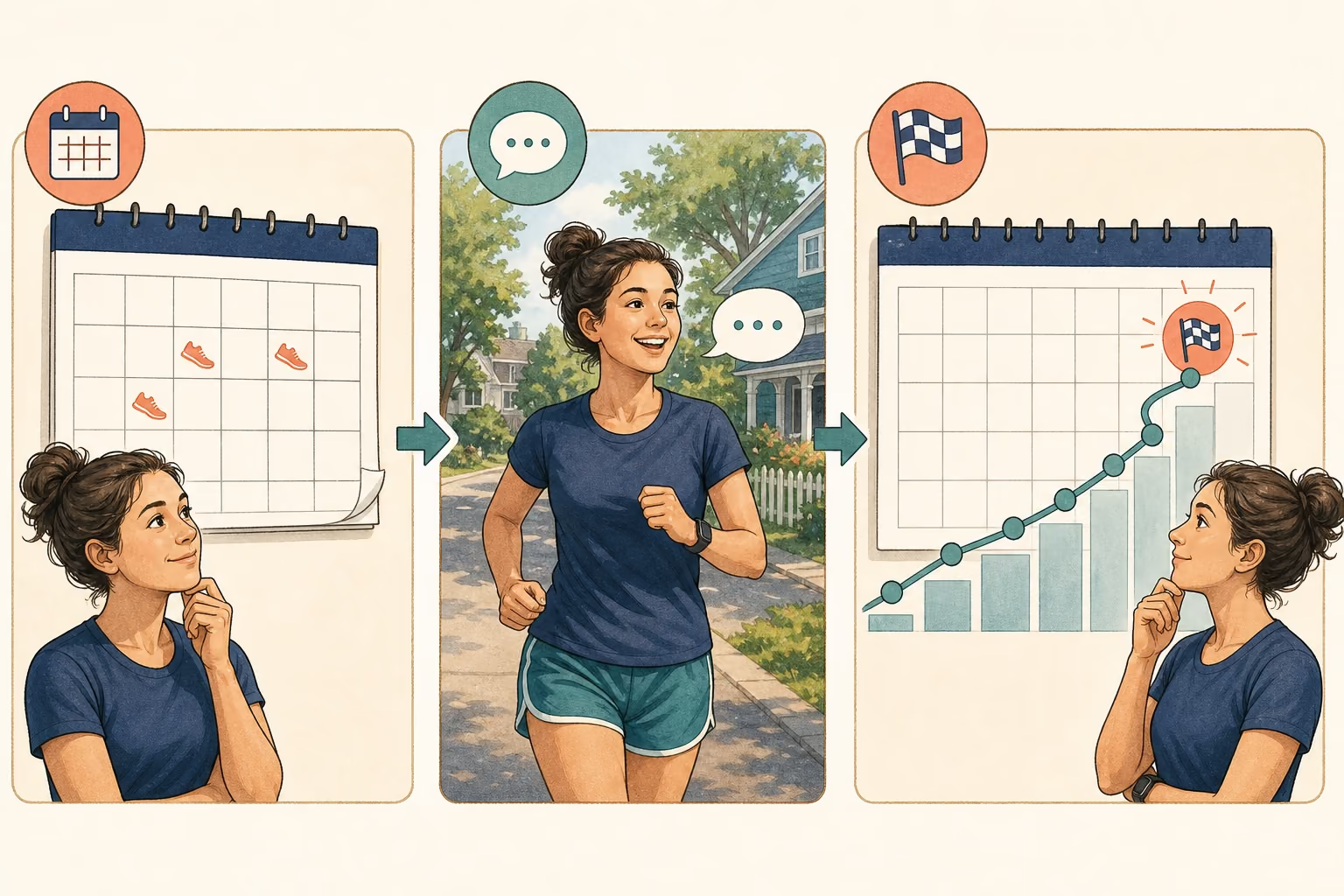
Four kinds of readiness to check
Routine readiness
Can you protect three movement or running windows most weeks? The sessions do not all need to be long, but they need to exist outside an idealized calendar. Include commuting, changing, route access, and family obligations when deciding whether a window is real.
If your current schedule changes weekly, a plan can still work, but you need rules for moving sessions. Preserve an easy day between demanding runs, keep one long-run opportunity, and accept that low-priority mileage may be dropped rather than repaid.
Running readiness
Running readiness means your first planned sessions resemble something you have recently tolerated. For a run-walker, that may be three outings of 25 to 35 minutes. For a continuous runner, it may mean several weeks of easy running with a longest outing near the first long run in the plan.
Fitness from swimming, cycling, or team sports is useful but incomplete. Running asks the body to absorb repeated landing forces. Treat impact tolerance as a skill to build even when your breathing suggests you could do more.
Calendar readiness
Count backward from race day, reserving the final one to two weeks for reduced training rather than catch-up. Then mark travel, work peaks, caregiving commitments, and likely weather barriers. What remains is your usable runway.
A beginner with little recent running may need a base phase before a twelve- or sixteen-week race block. Use the training-runway guide to count the base, race-specific block, taper, and known disruptions separately. If the event date cannot accommodate all of them, moving the race is the soundest adjustment. A date on a registration page does not obligate your body to skip steps.
Race-logistics readiness
Read the official cutoff, course terrain, aid-station plan, start time, and transportation instructions before registering. A race with a strict pace requirement may not suit a first run-walk attempt. A hilly course or hot season may require more specific preparation.
Also consider the practical cost: entry, travel, shoes, food, and time. The best goal is one you can support without turning every training decision into an emergency.
A readiness screen you can answer honestly
| Question | Ready signal | Build first |
|---|---|---|
| Can you schedule at least 3 sessions most weeks? | Specific days and backup windows are identified | Test a two-week routine before choosing the race |
| Does the plan's first week resemble recent training? | Frequency and longest run require only a modest step | Use a base phase or lower starting level |
| Can you keep an easy effort controlled? | You can talk in sentences or use planned walks | Practice short conversational run-walk outings |
| Do you recover enough to run again? | Ordinary fatigue settles and movement returns toward normal | Repeat or reduce the current load rather than progress |
| Is there calendar buffer? | Known disruptions and a taper fit before race day | Choose a later race or shorter preparatory goal |
| Does the event fit your likely pace? | Conservative pace plus stops is inside the official cutoff | Find a more generous event or extend preparation |
There is no universal minimum mileage
Search results often offer one weekly-mileage threshold as if it were an entrance exam. Mileage alone misses frequency, run duration, terrain, recent consistency, and the opening demand of the chosen plan. Ten miles spread across three controlled runs is a different starting point from ten miles completed in one painful outing.
A more useful comparison is plan-to-person fit. If your recent reliable week contains three runs totaling 8–10 miles and the plan opens near that pattern, you may have a workable starting point. If it opens at five days and 20 miles, the plan is not a beginner bridge for you regardless of what its label says.
Research on recreational half-marathon and marathon runners has found relationships among training volume, longest endurance run, performance, and running injuries. Because the study is observational, it cannot identify one safe or optimal number for every runner. It supports examining the complete training pattern, not chasing a magic threshold.
Green, yellow, and red planning signals
Green: the first month looks ordinary
You can name the days, the first long run is close to your current ability, and most sessions are conversational. Some challenge is expected, but the schedule does not require simultaneous leaps in frequency, distance, and intensity.
Green: you are willing to use walk breaks
A planned run-walk strategy expands the range of workable starting points. It is most useful when chosen from the start, practiced consistently, and checked against the course cutoff.
Yellow: your cardio is ahead of your running
A cyclist or gym regular may feel aerobically capable but have little recent impact exposure. Keep the early runs short and resist using breathing alone as permission to progress quickly.
Yellow: the calendar only works when nothing goes wrong
A plan without buffer is fragile. Add weeks, choose a flexible plan, or move the event before one work trip turns into a crisis.
Red: pain changes how you move
Do not use an online readiness score to explain away altered gait, limping, or escalating pain. General training guidance has reached its limit; stop and seek appropriate evaluation.
Red: exercise safety is uncertain
New concerning symptoms or a health situation that may affect exercise requires individualized professional guidance. A race goal can wait for a sound decision.
Runner scenario
Scenario: two runners with the same 5K time
Andre and Luis
Both recently completed a 5K in 34 minutes. Andre has run three days a week for four months. Luis completed the event after mostly cycling and two weeks of running.
- The decision
- They assume the shared finish time means they should start the same twelve-week half marathon plan.
- Recommended approach
- Andre can compare the plan's opening week with his established routine. Luis should first build several weeks of short, controlled running or run-walking, even though his cardiovascular fitness produced the same 5K result.
- Why
- A race result describes performance on one day. It does not reveal how the runner accumulated impact exposure or how reliably they recover. Recent training history is the more relevant readiness evidence.
Run a two-week readiness trial
- 1
Choose three realistic days
Schedule two shorter sessions and one slightly longer session. Keep at least one easy or non-running day between them if running is new.
- 2
Set a conversational ceiling
Run or run-walk at an effort that permits complete sentences. The trial is not a fitness test; it checks whether a routine can remain controlled.
- 3
Hold the structure steady
Repeat a similar pattern in week two. Do not add a fourth run or a speed workout just because the first week felt exciting.
- 4
Record practical friction
Note route safety, shoe comfort, time pressure, bathroom and water access, and which session was hardest to schedule. These details determine the plan you can use.
- 5
Review the 48 hours after each run
Ask whether ordinary energy and movement return toward baseline. Do not assign a score to one isolated sensation; look for worsening patterns or disruption to the next session.
- 6
Compare, then decide
If the routine fits and the plan opens close to it, begin. If not, extend the base phase, lower the starting demand, or move the event.
Match your starting point to a reasonable runway
| Starting point | Planning approach | Race-date caution |
|---|---|---|
| No regular exercise | Establish walking and then run-walk before a dedicated block | Do not treat an 8–12 week race plan as a complete couch-to-race pathway |
| Regular walking, no running | Introduce 2–3 short run-walk sessions and build impact gradually | Allow base weeks plus the full race-specific plan |
| 2 short runs per week | Stabilize a third day or a modest long-run progression | Choose a plan whose opening volume stays close |
| 3–4 runs per week for several months | Select 10–16 weeks based on goal and schedule | Shorter plans still require the opening week to fit |
| Returning after a long break | Use current ability, not historic personal bests | Build buffer for a conservative re-entry |
Questions that change the readiness decision
What if I am heavier, older, or slow?
None of those labels alone decides readiness. Training history, current function, available time, event cutoff, and recovery pattern provide more useful information. Do not use an online chart to convert body size or age into a verdict.
Use pace only where logistics require it. Calculate whether a conservative run-walk pace meets the cutoff, including stops. If it does not, choose a more generous event or a longer build rather than forcing training pace prematurely.
What if I have completed another endurance event?
Cycling centuries, long hikes, and swimming events demonstrate patience and aerobic work, but they do not provide the same running preparation. You may learn pacing and fueling quickly while still needing a novice running progression.
Keep the sport that built your fitness if it fits, but avoid using it to fill every rest day. The running sessions must be absorbed, not merely added to an already full endurance schedule.
What if I am nervous about being last?
Look for published results, course cutoffs, and walker policies. A welcoming event with a generous limit may be a better first race than a prestigious course with strict checkpoints.
Train the strategy you will use. Starting too fast to escape the back of the field usually spends energy without changing the fundamental race. Controlled early effort gives you more options later.
Readiness edge cases that need a different question
You can run, but only on a treadmill
Treadmill consistency is real running preparation, but an outdoor road race adds wind, turns, surface changes, self-selected pacing, and weather. You do not need to abandon the treadmill. Add short outdoor easy runs gradually and learn how effort translates when the belt no longer sets the pace.
If outdoor access is unsafe or climate makes it impractical, keep most training indoors and use suitable outdoor opportunities for gear and pacing rehearsal. Select a race whose terrain and likely conditions do not introduce every variable at once.
Your schedule supports only two runs
Two runs can improve fitness, but they give a half marathon plan little room to distribute the long run and other practice. Before registering, run a two-week calendar experiment to see whether a third short session can exist. It may be 20 minutes near work rather than a full conventional workout.
If two is the true limit, do not compress a four-day plan into two large sessions. Choose a later goal, a shorter event, or individualized guidance that accounts for the constraint. Cross-training supports general fitness but does not reproduce all running practice.
Your old personal best is much faster than current running
Historic fitness can make conservative training feel emotionally difficult. It may help you recognize effort and routine, but it does not establish current tolerance. Base the opening plan and goal pace on recent completed training and, later, a recent race or controlled fitness estimate.
Avoid recreating an old peak by jumping directly to its workouts. A return block should look modest relative to memory and appropriate relative to now.
The race is for charity or a group commitment
A cause and teammates can strengthen commitment, but they do not change the training runway or cutoff. Tell the group your intended run-walk pace and confirm whether participation can shift to a shorter distance, volunteer role, or later event if preparation stalls.
Make the contingency before it is needed. A clear alternative reduces the temptation to hide readiness concerns to avoid disappointing other people.
What the two-week trial should lead to
| Trial result | Decision | First action |
|---|---|---|
| All 3 sessions fit; effort controlled; recovery stable | Begin a plan whose opening week matches | Keep the first week deliberately familiar |
| Sessions fit, but run portions are too hard | Use a more conservative run-walk base | Shorten runs and lengthen walks without adding time |
| Running feels fine, schedule fails | Solve calendar friction before adding load | Move sessions, find backup route, or reduce target frequency |
| One session repeatedly disrupts several days | Hold or reduce the dose | Shorten the long outing and repeat the week |
| Event cutoff leaves almost no margin | Select a more suitable event or longer build | Compare official policies before paying |
| Pain changes movement or safety is uncertain | Do not progress through the screen | Seek appropriate individualized guidance |
Readiness is stronger when the goal has layers
Set an A goal you control, such as starting at planned effort and following the fuel routine. Add a B outcome such as completing under the official cutoff, and a C outcome such as reaching a specific time only when current evidence supports it. Layered goals prevent one ambitious number from making every training decision binary.
A finish goal still needs a pacing plan. Estimate a conservative elapsed pace from training, include walks and stops, and compare it with official checkpoints. A time goal needs more evidence: sustained weekly training, workouts related to race effort, and a recent performance estimate. Wanting the number is not the same as being ready to train for it.
Revisit the goal after several weeks. If training becomes more stable, the race objective can become more specific. If life load rises or the long run stalls, protect a controlled finish or change the event. Readiness is not a one-time judgment made at registration; it is a series of honest updates.
Make the decision today
- 1
List your last four weeks
Record actual running days, total time or miles, and longest outing. Use completed training, not the schedule you intended to follow.
- 2
Inspect the candidate plan
Compare the first two weeks with your record. Flag every increase in days, volume, long-run length, and intensity.
- 3
Audit the event
Read the official cutoff, terrain, date status, and aid-station details. Confirm that your intended strategy is welcome.
- 4
Choose one of three outcomes
Begin the plan, build a base first, or select a later/more suitable race. The readiness checker can organize the inputs, but you make the final judgment.
Put it into a plan
Turn this guidance into your next useful step.
Use a free resource to explore your options, or build a race-specific plan around your date, availability, and current fitness.
Check your readinessKeep learning
Related resources
Couch to Half Marathon: A Realistic Starting Guide
Learn how to build from little or no running toward a first half marathon with a longer, beginner-friendly runway.
Read guideHow Long to Train for a Half Marathon
Choose an 8-, 12-, or 16-week half marathon training timeline based on your current running base, race goal, and available time.
Read guideYour First Long Run: A Beginner’s Guide
Prepare for your first half marathon long run with easy effort, route planning, fueling practice, and a manageable progression.
Read guideQuestions runners ask
- Do I need to run 3 miles before starting half marathon training?
- No universal distance is required. The plan's opening sessions should be close to what you can repeat now. A runner using planned walk breaks may be ready without a continuous 3-mile run; a plan that begins with 5- or 6-mile outings would still be inappropriate for that starting point.
- Can I prepare for a half marathon in 12 weeks from no running?
- Twelve weeks from no running is an aggressive timeline because it combines learning to tolerate running with race-specific endurance. Some people may finish using walking, but completion is not the only consideration. A base phase plus a full training block, or a later race, creates more room for gradual work and disruptions.
- Does finishing a 5K mean I am ready?
- A 5K finish is useful evidence, but your preparation matters. Several months of repeatable 5K training provides a stronger base than one event completed from general fitness. Compare your recent weekly routine—not only the result—with the half marathon plan's opening weeks.
- How do I check a race cutoff for run-walking?
- Find the official total limit and intermediate checkpoints. Convert your intended run and walk intervals into a conservative average pace, then add time for aid stations, crowds, and bathrooms. If the margin is small before training begins, choose a race with a more generous policy.
- Should I get a medical check before training?
- A generic article cannot decide that for you. If you have concerning symptoms, a health condition that affects exercise, a significant recent illness or procedure, or uncertainty about safety, seek individualized advice. Do not use a readiness score as medical clearance.
- What if the readiness check says I need more time?
- Use the result to build a base, not to abandon the goal. Establish a repeatable three-day routine, progress run-walk duration gradually, and reassess after several stable weeks. Moving the race can preserve the goal while giving the training process enough space.
Sources and methodology
This guide is educational, not medical advice. It is written from general training principles and linked primary or official references; use judgment for your own conditions and consult a qualified professional for individual health concerns. Read our editorial methodology.
- ACSM's Guidelines for Exercise Testing and Prescription — American College of Sports Medicine. General exercise-training principles and progression guidance.
- Physical Activity Basics — Centers for Disease Control and Prevention. Public-health guidance on physical activity and its role in health.
- Training volume and longest endurance run related to performance and running injuries — Scandinavian Journal of Medicine & Science in Sports. Observational study of recreational half-marathon and marathon runners.